Why training dependencies slow AI teams down
Most AI projects don’t slow down because models can’t be trained; they slow down because training is chained to other teams and scarce resources. A “simple” accuracy boost often requires fresh labeled examples, a domain expert to define edge cases, data engineering to backfill missing fields, and an infra window to rerun pipelines. Each link adds wait time, handoffs, and coordination risk. Even when you have budget, the real constraint is calendar time: approvals, privacy review, and dataset versioning. The result is a product loop that can’t iterate at the pace users change.
These dependencies also make performance hard to reason about. If quality improves after a retrain, was it the new data, a labeling rule change, or a quiet shift in production traffic? Teams end up debating anecdotes instead of measuring cause and effect. Retraining can look cheap on a per-run basis, but the hidden costs accumulate in labeling spend, expert attention, revalidation work, and the opportunity cost of freezing features while you “get the next dataset right.” That’s the bottleneck “self-learning” claims to remove—sometimes legitimately, often partially.
What “self-learning AI” actually means in practice

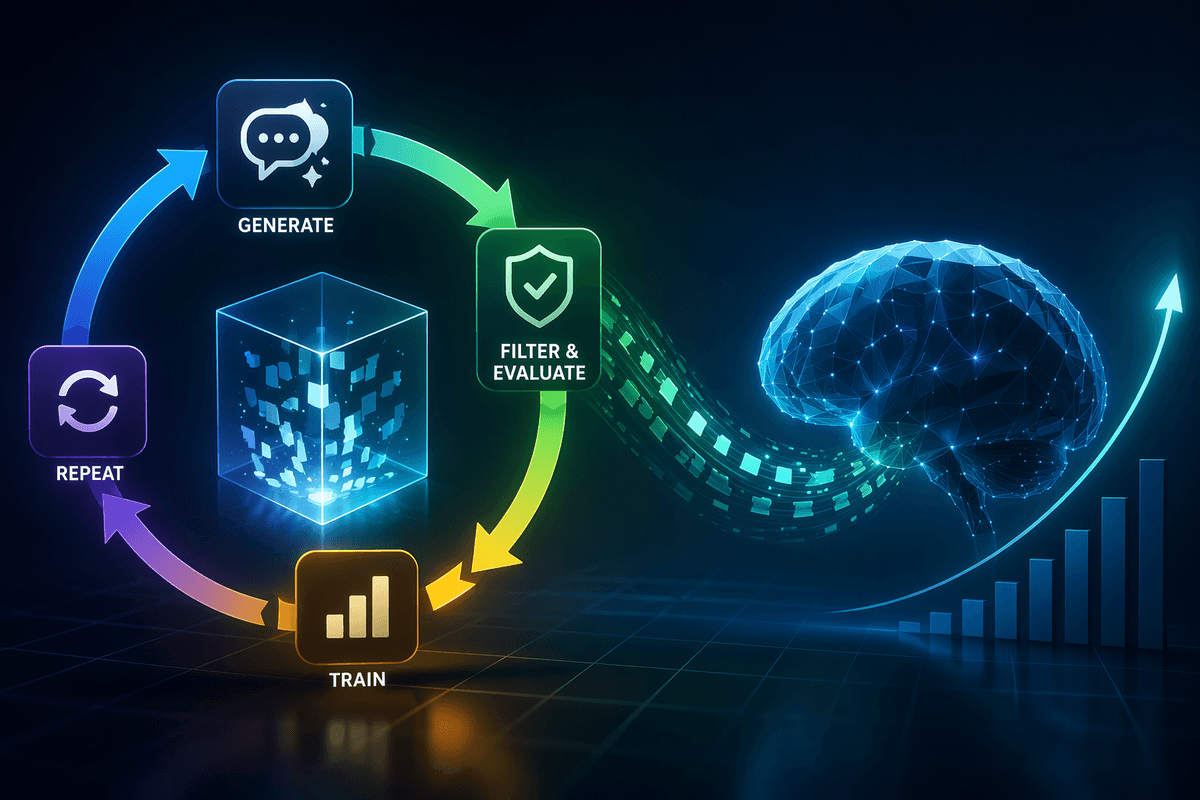
“Self-learning” rarely means a model quietly gets better on its own. In practice, it means you reduce how often you need hand-labeled datasets by harvesting learning signals from things you already have: user choices, corrections, clicks, time-to-complete, or downstream outcomes. Common patterns include using a strong “teacher” model to create pseudo-labels, learning useful representations from unlabeled data, and prioritizing only the most uncertain cases for human review. You still train, but you spend labels and expert time more selectively.
These signals are messier than curated labels. Users optimize for speed, not truth; logs reflect historical bias; and feedback can be gamed or correlated with UX changes. “Self-learning” adds governance work: defining what counts as a safe signal, separating experimentation from production learning, and setting rollback rules when quality drifts. It works best when outcomes are observable and frequent, and poorly when errors are rare but high-impact.
Map your current dependencies before you try to remove them
Picture the last time you wanted to “just improve the model.” List the non-model steps that had to happen first: which tables needed a backfill, who approved data access, which expert wrote labeling guidance, which reviewer signed off on evaluation, which pipeline had to be rerun, and which release gate forced you to wait. Write these as a dependency map with owners, typical lead time, and the artifact produced (label set, schema change, evaluation report, model card). The point is to find what actually drives schedule risk, not what looks expensive in a budget.
Then tag each dependency by why it exists: missing signals, unclear ground truth, compliance requirements, or inability to detect regressions in production. This is where “self-learning” often disappoints. It can reduce labeling, but it rarely removes privacy review, dataset lineage, or revalidation. If you can’t measure outcomes reliably, you’ll just trade labeled-data costs for longer debugging and incident response.
Which techniques reduce labeling and retraining most reliably

A familiar pattern is the “death by relabeling” cycle: the model misses a new edge case, the team asks for more examples, and weeks later you retrain—only to discover the real issue was unclear guidelines or a shifting definition of “correct.” The most reliable reductions in labeling come from techniques that make better use of what you already collect, without pretending you can eliminate human judgment altogether.
Teacher–student approaches are usually the first win. A stronger model (often a large general model) can generate pseudo-labels so humans only audit a sample or resolve disagreements. Active learning is another steady lever: route only the most uncertain or highest-impact items to experts, and let the system auto-handle the easy majority. For many domains, self-supervised or contrastive pretraining on your own unlabeled text, images, or logs reduces how much task-specific labeled data you need later, even if it doesn’t remove retraining.
Pseudo-labels can silently copy a teacher’s bias, uncertainty scores can be miscalibrated, and pretraining adds compute and MLOps complexity. These methods pay off most when you have high volume, stable definitions, and a way to spot “confidently wrong” outputs before they spread.
Feedback loops: turning real usage into safe learning signals
In most products, users already tell you what “better” looks like, but they do it indirectly. They rephrase a query, ignore a suggestion, accept an autocomplete, correct a field, or abandon a flow. These are weak labels, yet at scale they can outperform sporadic expert labeling—if you treat them as signals to rank options rather than as ground truth. A practical pattern is to log the model’s candidates, the final user choice, and the context, then train a lightweight scorer or reranker from pairwise preferences instead of retraining the entire model.
Safety comes from separating learning from serving. Collect feedback in a holdout pipeline, apply filters for bots, repeats, and UI-driven artifacts, and require agreement across multiple signals (for example, “user accepted” plus “no later correction”). High-risk domains often need “shadow learning”: propose updates, evaluate them offline and in limited traffic, and only then promote. The cost is real: instrumentation work, privacy review, and ongoing monitoring to catch feedback loops that reinforce bias or popularity over correctness.
How to prove it’s working without hidden training costs
You can usually tell when “self-learning” is real because the learning work becomes measurable, not magical. Start with a simple ledger: label hours per week, expert-review hours, number of retrains, training compute spend, and the engineering time spent maintaining feedback instrumentation and filters. Track these as first-class metrics alongside product quality. If accuracy improves but label hours and revalidation hours rise in parallel, you’ve just moved the cost to a different line item.
Proof also requires isolating cause and effect. Use fixed evaluation sets that don’t get refreshed by the same feedback stream, and run A/B tests where only the learning component changes (not the UI). Watch for hidden multipliers: extra offline evaluations, more frequent privacy reviews due to new logs, and longer incident response when feedback introduces subtle drift. A practical rule is to declare success only when quality improves and your “cost per point of improvement” drops for two consecutive release cycles.
A realistic adoption plan for teams starting this quarter
Most teams can start with a narrow loop that doesn’t change the core model yet. Pick one feature with high volume and low blast radius (search ranking, suggestions, triage), add logging for candidates shown, user choice, and later corrections, and build an offline evaluator that stays separate from that same feedback stream. Aim for a simple reranker or scorer trained on preference signals before attempting full fine-tunes.
Run a four- to eight-week pilot with a weekly “training ledger” review: label hours, expert hours, evaluation time, compute spend, and incident time. Keep a hard rollback path, cap learning updates to a fixed cadence, and require human audit for the top failure modes. The practical constraint is staffing: instrumentation, privacy approvals, and monitoring often cost more than the first model update.