Why perception is the bottleneck in self-driving
A self-driving car can have perfect steering and braking logic and still fail because it misunderstood what was around it. The hard part isn’t staying in the lane on a sunny day; it’s reading an unstructured world where objects are partly hidden, moving unpredictably, and sometimes not even “objects” in the usual sense (a tarp, a stroller, a wheel rolling loose). Human drivers lean on context and time—what just happened, what usually happens here—to resolve ambiguity. Perception systems must recreate that under noise, glare, rain, and messy road markings, and they have to do it fast enough to be useful.
That’s why “AI improves perception” is less about flashy demos and more about reducing specific error types: missing a pedestrian in shadow, confusing a billboard reflection for a vehicle, or failing to track a cyclist through a brief occlusion. Each of those errors can cascade into bad planning because the car’s downstream modules only act on what perception claims is true. Progress is real, but expensive: it needs massive labeled data, careful handling of rare edge cases, and compute that fits within a car’s power and heat limits.
Sensors set the ceiling: camera, radar, lidar tradeoffs
Watch a typical driver-assist video and you’ll see why sensors “set the ceiling.” Cameras give rich detail—lane paint, signals, gestures—but struggle with glare, darkness, fog, and depth at long range. Radar is the opposite: it’s great at measuring distance and relative speed through rain or dust, yet it can be coarse and prone to odd reflections around metal structures, making it harder to separate adjacent objects. Lidar provides precise 3D geometry and helps with shape and distance, but it adds cost, packaging complexity, and can degrade in heavy precipitation or when lenses get dirty.
No sensor is a silver bullet, so teams stack them and let AI reconcile disagreements. That fusion can reduce misses and false alarms, but it also introduces practical constraints: calibration drift, blocked fields of view, higher compute load, and more ways for a single hardware issue to quietly erode performance.
From bounding boxes to full scene understanding
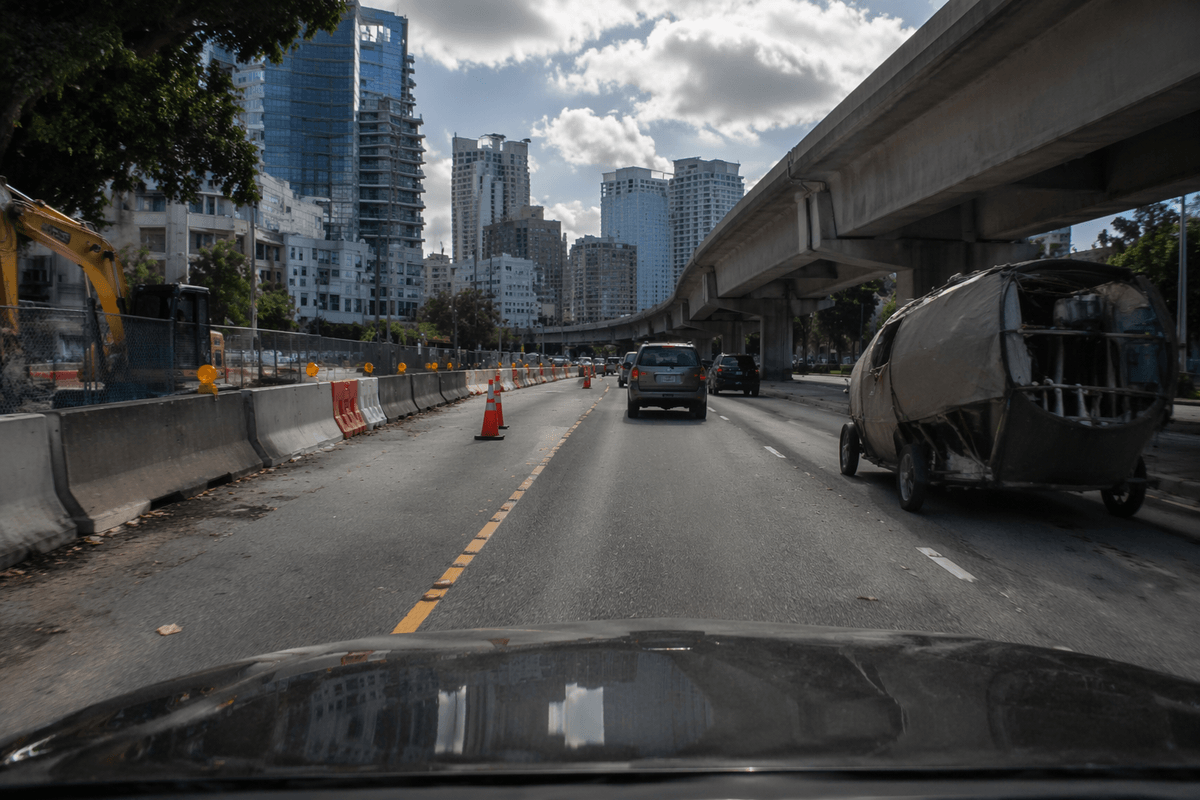
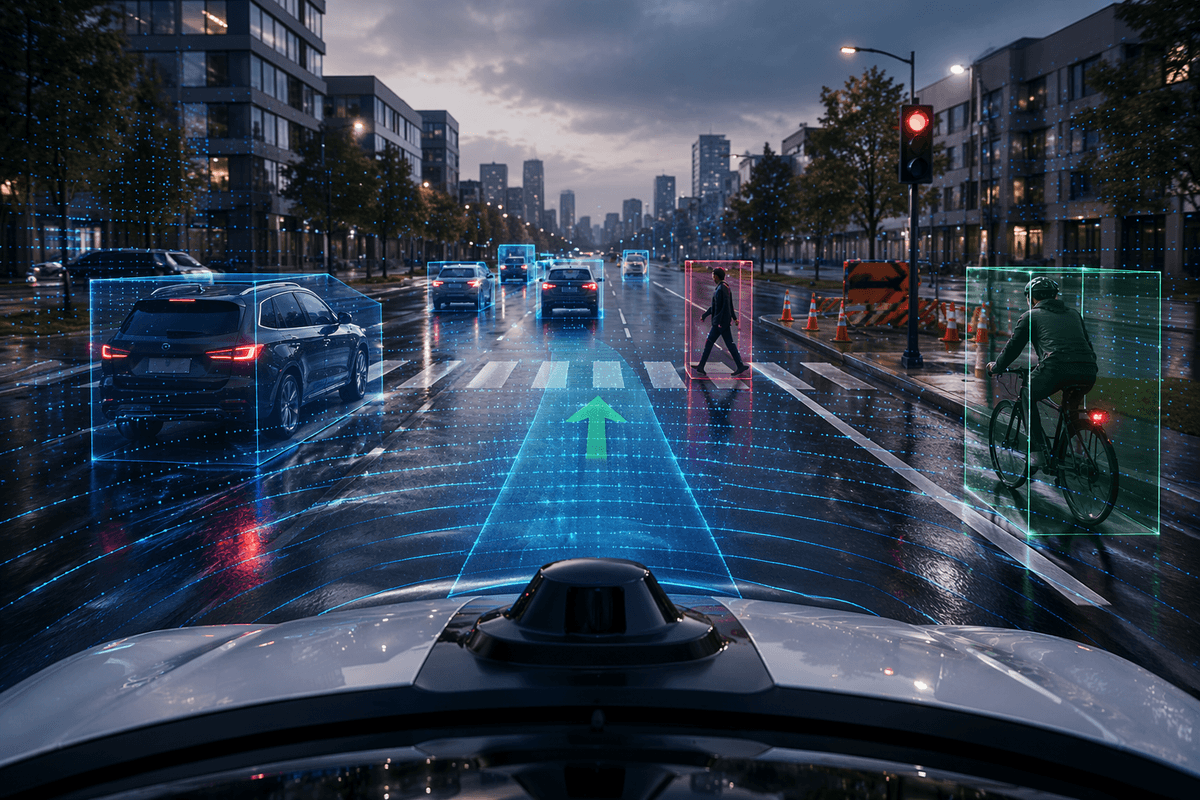
Early perception stacks treated the world like a checklist: find cars, pedestrians, bikes, and draw bounding boxes around them. That helps with basic collision avoidance, but it misses the driving meaning. A box doesn’t tell you whether a pedestrian is waiting at the curb or stepping out, whether a parked van is likely to hide a person, or whether a “clear lane” is actually blocked by cones and a flagger. It also breaks down in the messy cases that cause real incidents: partial occlusions, unusual vehicles, debris, and temporary construction layouts.
Newer approaches push toward scene understanding: estimating 3D position and motion over time, recognizing drivable space and lane topology even when paint is gone, and inferring intent cues like head pose, wheel angle, and yield dynamics at intersections. These models can become brittle when the training data underrepresents a local road pattern, and diagnosing why the system “believed” a wrong story is harder than debugging a missed box.
How modern AI models fuse signals and handle time
In practice, fusion is less like “averaging sensors” and more like keeping multiple imperfect viewpoints consistent. Modern stacks often convert camera, radar, and sometimes lidar into a shared 3D frame (frequently a bird’s-eye-view grid) so the model can reason about where things are, not just what they look like. Radar’s velocity helps disambiguate whether a blob is a moving car or a static sign; camera texture resolves which lane boundary is real; lidar geometry can anchor depth when vision is uncertain.
Handling time is where many gains show up. Instead of treating each frame as a fresh detection, models learn to carry forward short-term memory: track objects through occlusions, smooth jittery measurements, and predict motion based on a few seconds of history. Architectures like temporal transformers or recurrent fusion modules can “explain away” momentary glare or missed returns by leaning on what was consistent across frames.
The temporal fusion is compute-hungry and fragile to bad synchronization. Small timestamp errors, calibration drift, or a partially blocked sensor can create confident but wrong tracks that look stable precisely because the model is enforcing consistency.
Data beats novelty: training for the long tail
Anyone who has shipped a perception model recognizes the pattern: the offline metrics look great, a demo route runs smoothly, then a rare combination—low sun, dirty lens, a pedestrian behind a turning SUV, and temporary cones—triggers a mistake. That’s the “long tail”: scenarios that are individually uncommon but unavoidable at scale. New architectures help, but most real reliability gains come from grinding through data: collecting near-misses, hard negatives, and regional variations, then retraining until those specific failure modes stop appearing.
Teams typically build feedback loops around disengagements, safety driver interventions, and high-uncertainty moments, then prioritize labeling where it changes decisions, not where it’s easy. Labeling 3D, motion, and intent is slow and inconsistent across vendors, and even fleets struggle to capture enough examples of the weird cases—emergency scenes, unusual construction, animals—without years of driving or targeted data collection.
Real-time constraints: latency, power, and on-car compute
In a real car, perception can’t take “as long as it needs.” If the stack needs 200–300 milliseconds to fuse sensors, track objects, and predict motion, the vehicle has already traveled several meters, and that gap shows up as late braking, awkward merges, or overcautious stops. The hardest cases—night glare, rain spray, dense intersections—also tend to be the most compute-intensive, because the model has to integrate more frames and resolve more ambiguity.
That runs into power and heat. You can’t mount a data-center GPU with a fan wall behind the bumper; automotive compute has strict thermal envelopes, cost targets, and reliability requirements. More sensors and bigger models also increase bandwidth and memory pressure, which creates its own latency even when raw “TOPS” looks high on a spec sheet.
So progress is often about engineering discipline: quantizing models, pruning slow branches, scheduling workloads, and designing graceful degradation when a sensor drops or the compute budget is exceeded—because skipping frames or stalling isn’t an option at 70 mph.
Proving it’s safer: validation, uncertainty, and monitoring
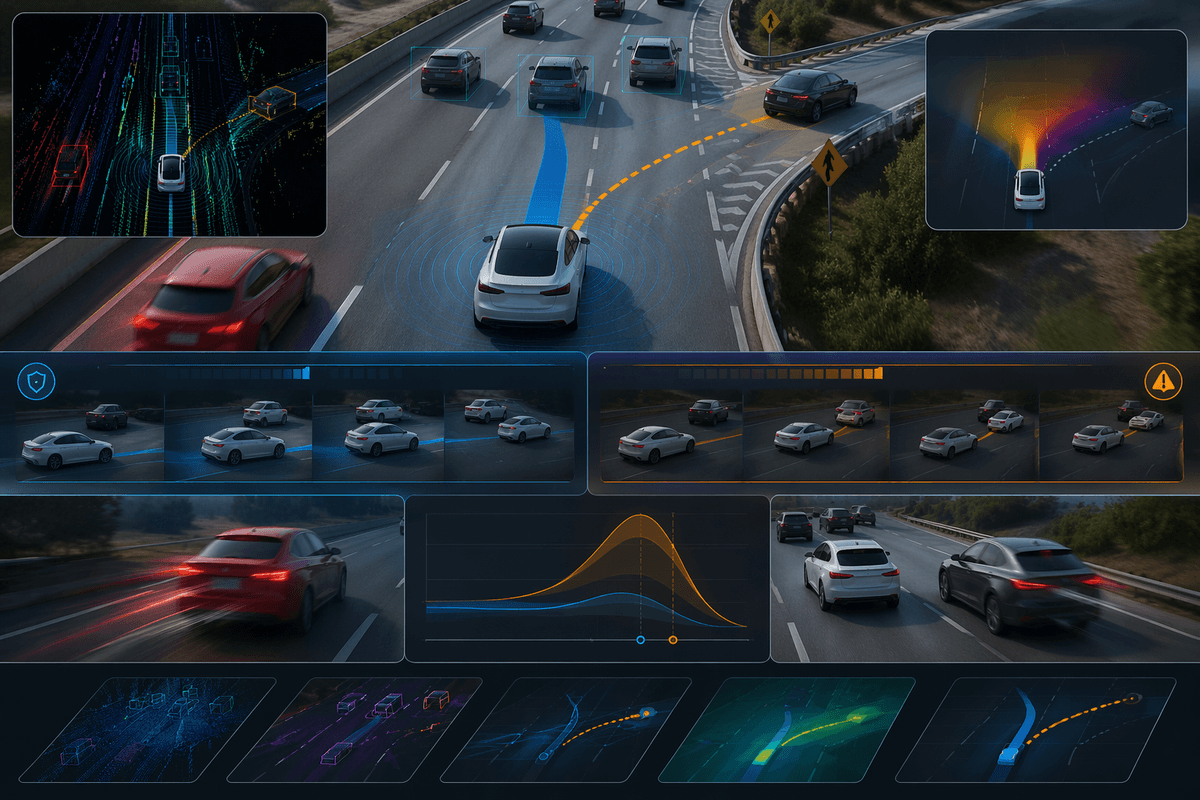
A slick demo doesn’t answer the real question: will it behave safely across months of weather, roadwork, and local driving norms? Teams rely on layered validation—offline benchmarks for perception accuracy, simulation to replay dangerous merges or cut-ins at scale, and tightly scoped on-road testing with conservative operational limits. The catch is exposure: the rare events you care about most (a child darting out, a police-directed intersection, a blown tire ahead) may not show up often enough to “prove” anything quickly, even with a big fleet.
Modern stacks try to make uncertainty explicit. Instead of outputting a single confident track, they estimate how unsure they are about an object’s position, class, or motion, and downstream planners can respond by slowing, widening following distance, or refusing a maneuver. This helps, but it’s not free: uncertainty can be miscalibrated, and overly cautious behavior can create new risks like getting rear-ended or blocking traffic.
Monitoring closes the loop after launch. Systems log high-uncertainty moments, odd sensor disagreements, and human interventions, then trigger targeted data collection and retraining. Credible safety claims usually include clear operating boundaries, failure reporting, and evidence of improving incident rates over real miles—not just better leaderboard numbers.
What’s next: scaling, regulation, and the remaining gaps
Watch where deployments expand: more cities, more weather, more construction, and more interactions with assertive human drivers. Scaling means confronting regional edge cases and keeping performance stable as the software, sensor supply, and vehicle platforms change. That pushes teams toward standardized data pipelines, repeatable calibration checks, and clearer “this is supported, this is not” operating limits that can survive fleet growth.
Regulation will likely reward transparency over hype: incident reporting, third-party audits, and continuous monitoring that can detect drift after updates. The remaining gaps are practical ones—handling rare but high-consequence scenarios, reducing overcautious behavior that disrupts traffic, and proving robustness when sensors are partially degraded. Progress is real, but it comes with ongoing cost: data collection, validation miles, and disciplined change control.