Why ‘complex air’ is the real challenge for autonomy
Autonomy looks easiest on a calm day: the aircraft follows a planned path, sensors are clean, and the control loops make small, predictable corrections. The real test is “complex air,” where the atmosphere changes faster than the vehicle can comfortably respond—gusts, sharp gradients, and turbulent pockets that don’t show up as tidy, steady wind.
In that environment, the problem isn’t only navigation. It’s estimating what the air is doing right now, separating real motion from sensor noise, and deciding how hard to fight it without inducing oscillations. Small drones and light aircraft have limited control authority and energy margins, so an “AI pilot” can’t simply muscle through; it needs clear limits, conservative envelopes, and a way to recognize when conditions are becoming unsafe.
This is where hype tends to hide: demos often assume that wind is uniform, visibility is good, and disturbances are brief. Operational reality includes uneven terrain, buildings, and convection that create localized effects the vehicle may encounter with little warning. The most practical question becomes less “Can it fly itself?” and more “Can it detect complex air early enough to adapt, or to stop the mission before it runs out of options?”
The edge cases: gust fronts, shear, icing, and rotor zones
A familiar failure pattern in autonomy tests is the “sudden surprise” the crew can feel coming, but the system treats as ordinary noise until it’s too late. Gust fronts are a good example: an abrupt wind shift and spike in airspeed can turn a stable approach into a high sink-rate event. Low-level wind shear can look like a small tracking error right up to the moment it demands more thrust or pitch authority than the vehicle has. Near ridgelines, rotor zones and lee-side turbulence can flip a smooth wind into violent, rolling air in a few seconds, especially for lighter aircraft.
Icing is a different class of edge case because it changes the aircraft, not just the environment. Even thin accretion can distort lift and stall margins while degrading pitot/static and angle-of-attack readings, which then corrupts the control system’s “truth.” Avoidance is often the only realistic strategy, but that requires conservative envelopes, accurate detection, and the operational willingness to reroute or abort—costly in time, battery, and schedule.
Sensing messy air: what the AI can actually observe
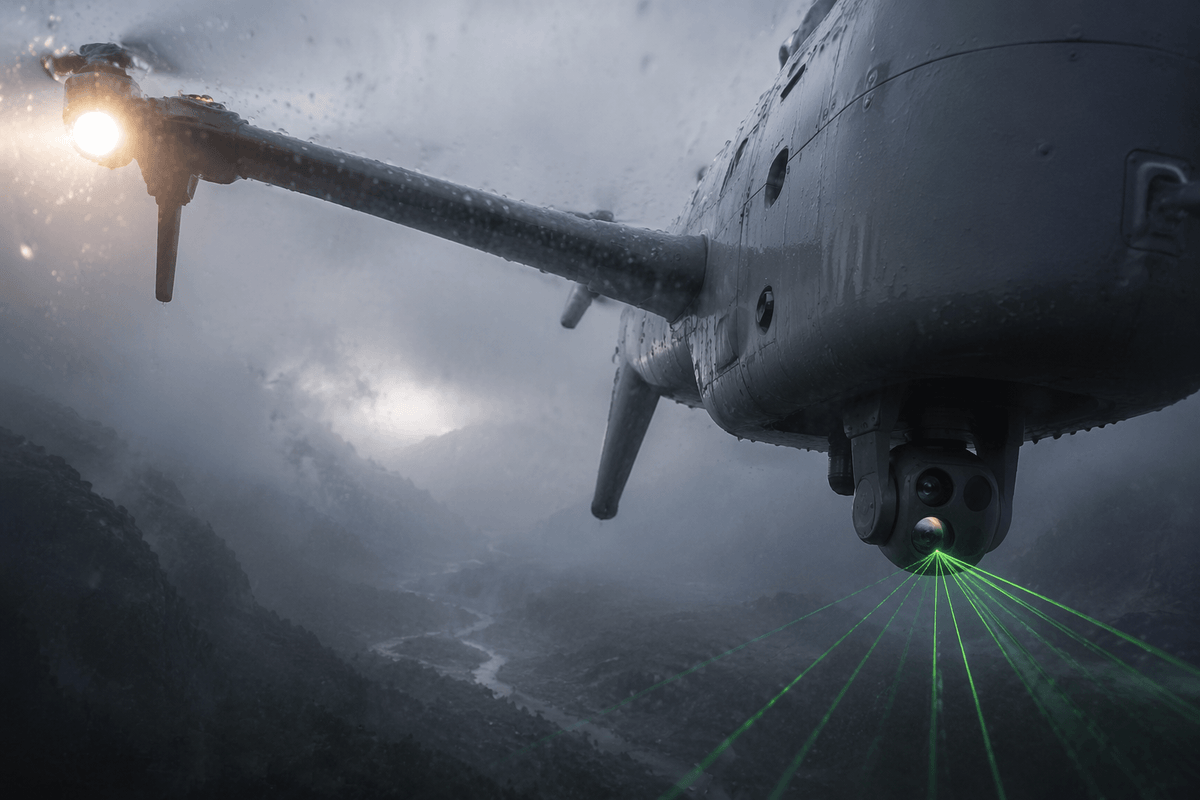
On a gusty day, the autonomy stack isn’t “seeing turbulence” so much as inferring it from mismatches: the GPS says you drifted, the IMU says you accelerated, the air data says airspeed changed, and the controller knows what it commanded. That fusion can estimate wind and vertical air motion locally, but only where the aircraft already is. It does not give a clean picture of the next 200 meters, and it can be fooled by latency, vibration, and temporary sensor dropouts.
Different sensors fail differently in complex air. Pitot/static can be corrupted by rain, icing, or unusual flow angles; GNSS can be multipath-limited near structures; magnetometers are unreliable around steel and power lines; cameras and lidars lose performance in haze, glare, and precipitation. Redundancy helps, but it adds weight, power draw, integration time, and still leaves a basic constraint: the aircraft can measure its own motion precisely, while the surrounding air remains partially observed and often revealed too late.
From measurements to forecasts: nowcasting the next few seconds
A practical autonomy system treats “the next few seconds” as its forecast horizon, because that’s all its sensors can reliably support in messy air. It takes current estimates of wind, gust rate, and vertical acceleration and projects them forward just far enough to choose a safer control response. In effect, it’s less like predicting weather and more like predicting the aircraft’s immediate energy state: will you have enough airspeed, thrust margin, and attitude authority if the current trend continues for another two or three seconds?
The simplest nowcasts are filters that assume wind changes smoothly and discount outliers. That works until it doesn’t—gust fronts and rotor zones change faster than “smooth” models allow. More advanced approaches use short rolling histories of IMU, air data, and control effort to estimate gust shapes and likely recurrence, sometimes adding cues like onboard radar or optical flow where available. The model can only learn patterns it has just experienced, and any forecast is only as good as the sensors feeding it.
Operationally, good nowcasting looks boring: earlier speed buffers, shallower bank commands, and fewer last-second corrections. The cost is efficiency. You may fly longer, climb sooner, or refuse approaches that a skilled human might attempt, because the system is protecting the margins it can actually quantify.
Control under uncertainty: staying stable without overcorrecting
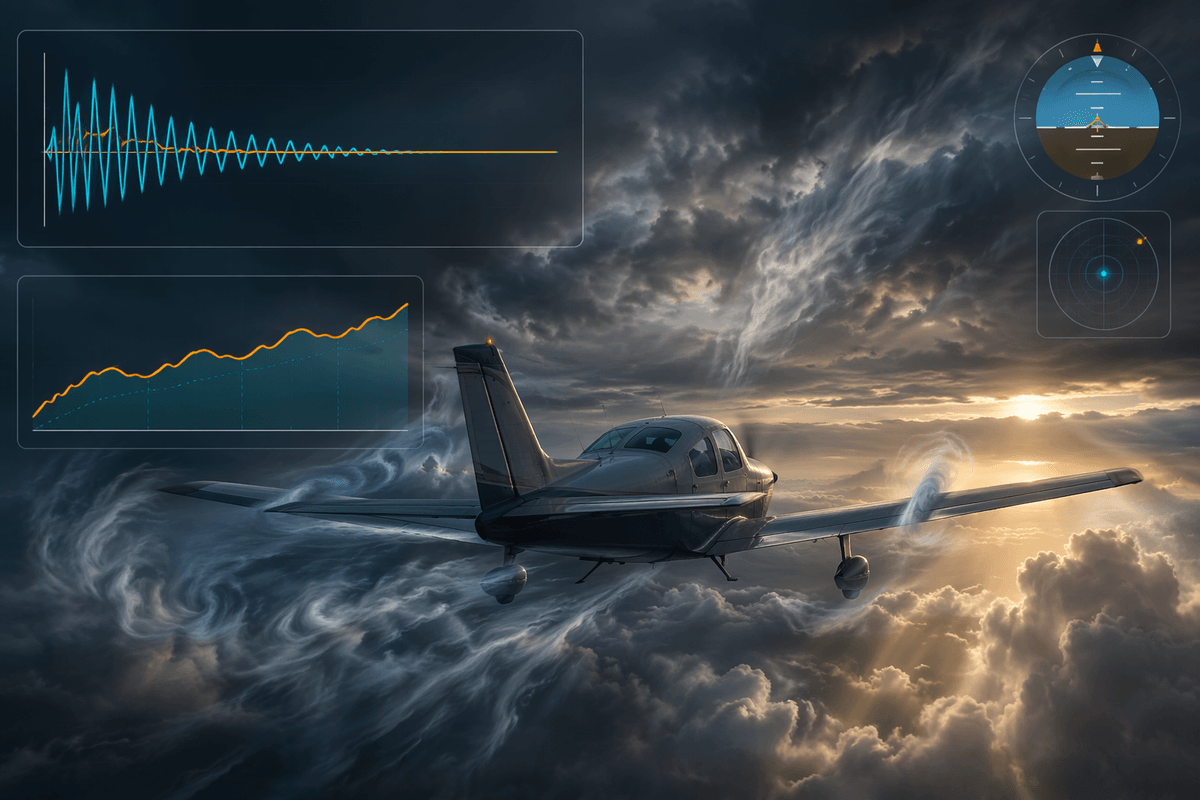
In complex air, the controller’s hardest job is deciding what not to do. If it treats every bump as a true trend, it will chase noise: rapid pitch and roll inputs that look “responsive” but can build into oscillations, waste energy, and increase stall risk. If it smooths too aggressively, it reacts late and can run out of thrust or attitude margin when a real gust sequence persists. Good behavior is usually measured in the frequency domain: damp the fast stuff, track the slower stuff, and keep the aircraft’s angle of attack and load factor inside known limits.
Most autonomy stacks handle this with layered control: a fast inner loop that stabilizes attitude using IMU data, and a slower outer loop that manages path, airspeed, and altitude. Uncertainty shows up as changing control effectiveness—icing, battery sag, prop wash changes—so the system needs online gain scheduling or adaptive elements, plus hard protections that cap bank, pitch rate, and commanded accelerations. The trade-off is comfort and precision: to stay stable, it may accept larger path error rather than “fight” the air into a loss-of-control corner.
When to reroute, climb, or abort: autonomy’s risk choices
A real autonomy stack earns its keep when it decides the mission is no longer the priority. The inputs are plain: shrinking airspeed margin, rising control effort, repeated limit hits (bank, pitch rate, thrust), worsening sensor quality, and growing mismatch between predicted and observed motion. Those are operational triggers, not “AI intuition,” and they should map to pre-approved playbooks: add speed buffer, widen turns, switch to a higher-altitude corridor, or hold in a safe loiter while conditions stabilize.
Reroute and climb are often cheaper than they look, because they buy time and smoother air, but they aren’t free. Climbing can push a drone into clouds, icing layers, or controlled airspace; rerouting can exceed battery reserves or break geo-fence constraints. Abort logic needs to be explicit about where it will go, what it will avoid, and how it behaves when links degrade—because “safe landing” is sometimes just the least-bad option in the remaining energy and space.
Proving it’s safe: testing, simulation, and certification realities
In practice, “safe in complex air” has to be demonstrated as a set of bounded behaviors: what winds, gust rates, visibility, and sensor degradations the system is approved to face, and what it does when those bounds are exceeded. That pushes testing beyond scripted demos toward repeatable stress: hardware-in-the-loop rigs, Monte Carlo runs over wind fields and sensor faults, and flight tests that target limit hits, abort logic, and recovery margins.
Simulation is essential, but it is also where teams can fool themselves if turbulence and icing are modeled too cleanly, or if sensor dropouts look nicer than reality. Certification and approvals (even outside full type certification) tend to reward clear envelopes, traceable requirements, and fail-safe defaults. The practical constraint is cost: building evidence takes time, flight hours, and disciplined configuration control, and it often narrows operations before it expands them.