Why AI teams still stumble at the hardware–software boundary
A common pattern: a model is fast on a single developer GPU, then slows down or becomes expensive in production even though “the same code” is running. The gap usually isn’t mysterious bugs. It’s that model choices and serving choices quietly assume things about memory capacity, bandwidth, interconnect speed, and supported precisions that the target hardware may not match.
Teams also split along tool boundaries. ML engineers think in layers, tokens, and batch size, while platform teams think in kernels, drivers, NUMA, and quotas. Each side makes reasonable local optimizations that collide later—like increasing batch size to improve throughput, only to trigger out-of-memory, higher latency, or worse tail behavior.
Even when the hardware is “powerful,” the winning path depends on constraints that aren’t obvious from peak FLOPS: how often data moves, which ops fuse well, where compilation falls back to slower kernels, and what monitoring can actually attribute. Fixing this costs time, requires access to representative hardware, and often forces uncomfortable trade-offs between accuracy, latency, and unit economics.
Start with the target workload, not the latest chip

The most useful starting point is a workload sketch that looks like production: model family and size, sequence lengths, target latency (p50 and p99), concurrency, and how requests arrive (steady vs spiky). A chip that looks great on a single-stream benchmark can disappoint when you add real batching limits, context growth, or streaming tokens that keep the batch from staying full. “What is my typical input, and what do I do when it doubles?” is often more predictive than any spec sheet.
From that sketch, you can derive a few hardware-facing numbers: required memory capacity for weights plus KV cache, expected memory bandwidth pressure, and whether you’re compute-bound or movement-bound. That tells you if you should pay for larger memory, faster interconnect, or simply more cheap devices with better utilization.
Getting this right usually costs a small prototype on representative hardware, plus time to instrument it. That effort is cheaper than buying the wrong fleet and spending months chasing surprise bottlenecks.
The constraints that quietly dominate performance and cost
You’ll usually feel the real constraints first as “why can’t I raise batch?” or “why did latency jump when traffic got spiky?” Memory capacity is the obvious gate: weights plus activations plus KV cache have to fit, and KV cache scales with sequence length and concurrent sessions. When you miss by a little, you don’t get “a little slower”—you get paging, forced offloads, smaller batches, or shorter contexts, all of which change unit economics fast.
After it fits, bandwidth and data movement often dominate. Attention-heavy inference can spend more time reading and writing than multiplying, so higher peak FLOPS won’t help if your memory subsystem is saturated. PCIe vs NVLink-class links matter when you shard weights, do tensor parallel, or move activations across devices; a “cheap” scale-out choice can quietly tax every token.
Precision support and power are the constraints that show up on the bill. If your stack falls back to FP16/FP32 because a kernel or quantization path isn’t stable, you’ll pay in memory, throughput, and energy. Lower power limits or shared-cluster caps can also flatten performance, so plan for what you’re allowed to sustain, not what the datasheet advertises.
Model choices that make hardware happier (without wrecking quality)
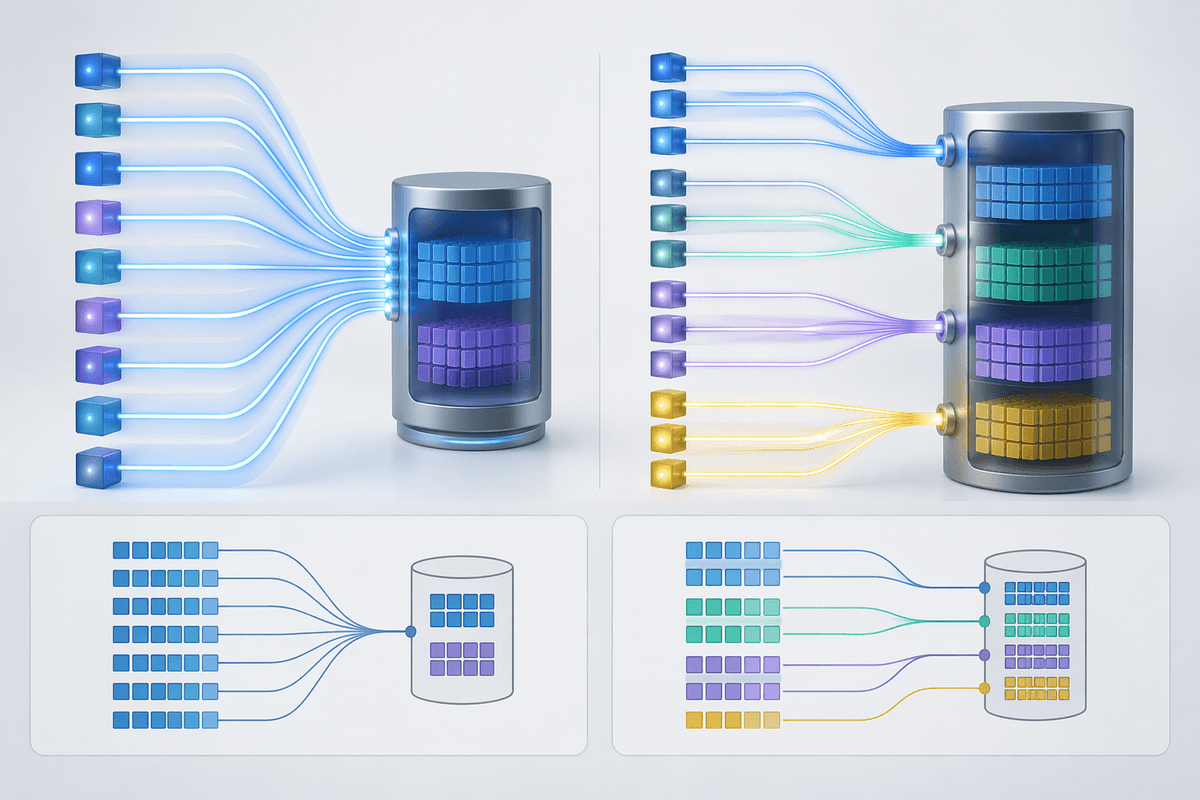
A familiar surprise is that two models with similar offline scores can behave very differently on the same box. Architectures with heavy attention and long contexts tend to be memory- and bandwidth-hungry because KV cache growth tracks sequence length and concurrency. If you can meet product needs with shorter context, sliding-window attention, multi-query/grouped-query attention, or retrieval for “long memory,” you often unlock higher batch, steadier p99 latency, and cheaper instances without changing the hardware.
Weight size is the other lever that shows up immediately in capacity, bandwidth, and interconnect traffic. Smaller variants, distilled models, and parameter-efficient adapters can reduce the footprint enough to keep you on a single device or avoid aggressive sharding. When you do need quantization, pick it as a deployment constraint, not a last-minute trick: some paths are fast only if your kernels and runtimes truly support INT8/FP8 end to end, and the accuracy cost can concentrate in specific languages, formats, or tool-use behaviors.
Even “model-side” choices like activation functions, normalization, and layer shapes can decide whether kernels fuse cleanly and stay on the fast path. The practical constraint is iteration cost: validating quality across real traffic, prompts, and safety filters takes time, and you may need parallel evaluation just to avoid trading one production surprise for another.
Compilers, runtimes, and kernels: where theory meets reality
The common “it should be faster” moment shows up when you switch GPUs, turn on compilation, or adopt a new runtime and nothing improves. The model graph may look identical, but the executed program is a pile of kernels with specific launch shapes, memory layouts, and fusion opportunities. If an op can’t fuse (because of dynamic shapes, uncommon layer patterns, or unsupported precision), you get extra reads and writes, more kernel launches, and higher latency—especially at small batch sizes where overhead is a larger share of the work.
Runtimes add another layer of reality: allocator behavior, CUDA graph capture (or lack of it), KV-cache paging strategies, and how batching interacts with streaming token output. One serving stack may prioritize stable p99 latency by keeping batches small; another may chase throughput and create head-of-line blocking under spiky traffic. These are product choices disguised as “just implementation.”
Kernel-level wins often require profiling tools, vendor libraries, and careful version pinning, and regressions can appear after a driver or framework upgrade. Treat the compiler/runtime as part of the deployment surface area, not an interchangeable detail.
Benchmarking that predicts production, not just a demo win
A demo benchmark usually fixes the inputs, runs at steady load, and reports a clean throughput number. Production rarely cooperates. Sequence lengths vary, concurrency rises and falls, and token streaming keeps batches from staying full. If you don’t measure p50 and p99 latency under realistic arrival patterns, you can “win” a benchmark while losing the user experience and the cloud bill.
Make the benchmark answer a concrete question: cost per successful request at an agreed quality level. That means holding constant the whole serving shape—batching policy, max context, KV-cache settings, precision, and any fallback paths when compilation or quantization fails. Include warmup, model load time, and recovery after a restart, because autoscaling and deploys turn those into real downtime.
The hard part is getting representative traces and running them on representative hardware. You may need to sanitize real prompts, replay traffic bursts, and test noisy-neighbor effects if you’re on shared GPUs. It costs effort, but it replaces “peak tokens/sec” with a number that procurement, SRE, and product can all reason about.
A practical co-design workflow to keep teams aligned
Most alignment problems start with a simple mismatch: model owners optimize “tokens/sec on my box,” while platform owners optimize “stable p99 under shared constraints.” A workable co-design loop begins by agreeing on a single scorecard that mixes user experience and cost: p50/p99 latency, cost per successful request, max context, steady-state throughput at a defined concurrency, and operational constraints like power caps or GPU quotas. Put it in a shared doc and treat changes as product-impacting, not “just tuning.”
Turn that scorecard into a small set of knobs each team can change safely: batching policy, precision/quantization target, max sequence length, parallelism strategy (single device vs sharded), and the serving runtime configuration. Assign an owner and a rollback plan for each knob, because “faster” changes often fail in production due to memory headroom, kernel fallbacks, or tail latency under bursty traffic.
Run a weekly “fit review” on representative hardware using the same trace replay, pin the full stack (driver, framework, runtime, kernels), and log deltas as decisions with dates and rationale. The cost is access to the right hardware and disciplined version control, but it prevents months of re-learning why the same model behaves differently across fleets.
Closing the loop: treat hardware–software fit as a product decision
A familiar failure mode is treating performance work as a late engineering cleanup, after product has already promised context length, latency, and price. Hardware–software fit works better when it is owned like any other product choice: define the SLA and “acceptable quality” thresholds, then choose the model, precision, runtime, and fleet shape that can meet them with headroom. If you can’t, you change the promise (shorter context, higher latency, lower concurrency) rather than quietly burning money.
Put procurement and deployment behind the same gate as feature changes: a trace-based scorecard on representative nodes, with a signed-off cost-per-request target. The constraint is organizational, not technical—running these tests takes scarce hardware time, and it can slow launches. The payoff is fewer surprise rewrites, and decisions that stay stable when traffic, drivers, or models change.