Why “self-learning” is suddenly a scaling advantage
Teams used to assume better language models mostly meant “more”: more GPUs, more web text, more time. That still works, but the cheapest gains are gone. A lot of public text is duplicated, low-signal, or misaligned with the tasks people actually pay for—support, coding, analysis—so you end up spending compute rereading the internet.
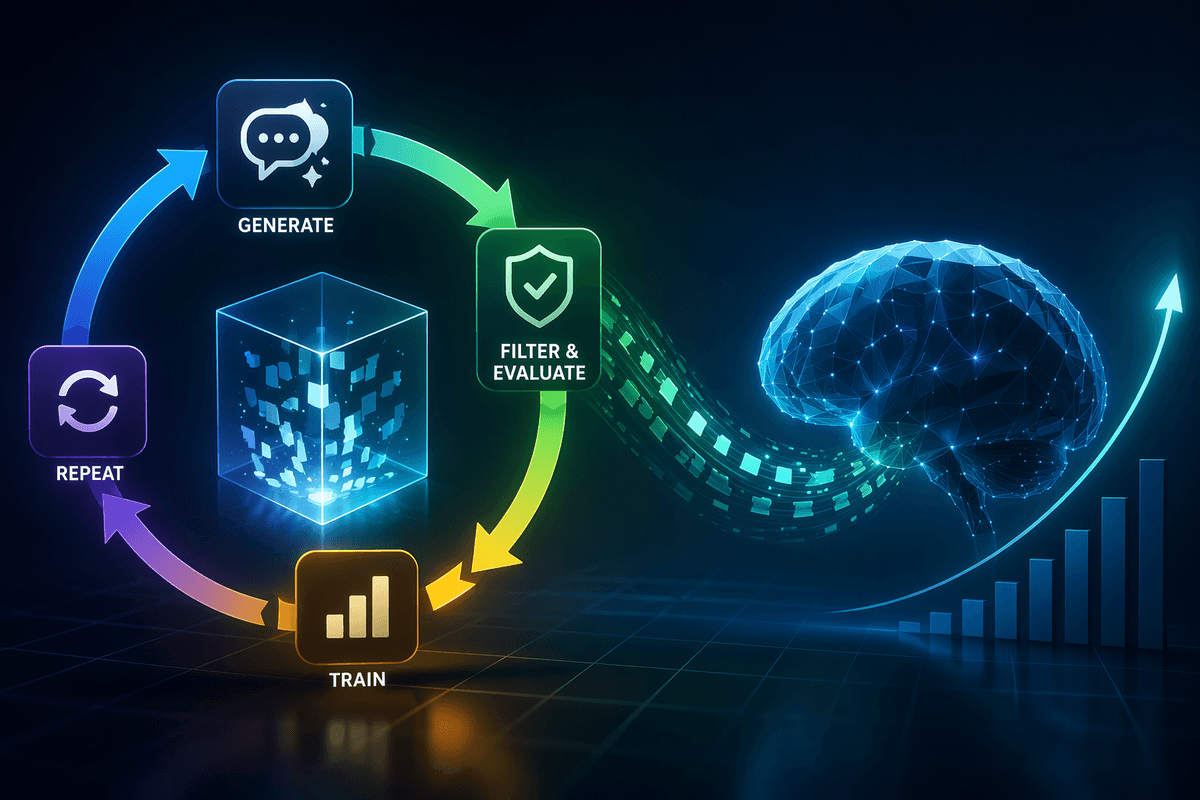
“Self-learning” is appealing because it turns the model into a data factory: it produces candidate answers, critiques, synthetic problems, or step-by-step reasoning, then trains on the best of it. When that loop is engineered well, each training token can carry more task-relevant signal than another crawl of noisy pages. You must pay for generation, filtering, and evaluation, and those costs can erase the advantage if quality control is weak.
What counts as self-learning in modern language models
In practice, “self-learning” isn’t a single technique so much as a family of training moves where the model helps create the targets it will later imitate or optimize. The simplest version is self-training: run the model on prompts, keep high-confidence outputs, and fine-tune to reproduce them. A richer version looks more like a classroom: the model generates questions, intermediate steps, and alternative solutions, then a separate judge (or a stronger checkpoint) scores what’s correct, useful, or safe enough to keep.
This differs from standard pretraining, which mostly absorbs whatever text exists, and from RLHF, which leans on human comparisons for reward. Self-learning tries to shift the bottleneck from “find/label more data” to “engineer better filters and graders.” The constraint is that graders are imperfect: if your evaluation proxy is easy to game or too narrow, you amplify the model’s quirks and call it progress.
Where classic scaling hits walls: data, noise, and cost
The scaling recipe of “just add more tokens” runs into mundane limits fast. High-quality text is a small fraction of the web, and the rest is repetition, SEO sludge, scraped duplicates, and forum noise. Even when you can collect it, you still have to de-duplicate, filter, and avoid contamination with your evaluation sets—otherwise you may be paying to memorize benchmarks while believing you trained capability.
More data also doesn’t mean more useful signal. As models get stronger, they’re bottlenecked by the long tail: rare, high-precision skills like debugging unfamiliar code, handling messy customer constraints, or doing domain-specific reasoning. Those examples exist, but they’re scattered, inconsistently formatted, and often gated behind licenses, privacy, or internal systems.
Training on extra low-signal tokens is expensive in the most literal way: GPU hours, energy, engineering time, and slower iteration cycles. If each new tranche of data adds marginal improvement, classic scaling starts to look less like compounding and more like paying rent.
How self-generated data can beat more raw web tokens

Consider a team trying to improve “helpful coding assistant” behavior by adding another few trillion web tokens. Most of what you buy with that spend is broad coverage, not targeted practice: lots of near-duplicate snippets, outdated APIs, and prose that never forces the model to resolve an error, choose a trade-off, or follow a tight specification. Self-generated data can concentrate training on the hard parts by manufacturing the exact situations you care about—buggy patches with hidden edge cases, ambiguous requirements that need clarification, or multi-step tasks where intermediate mistakes are common.
The advantage is density: a synthetic batch can be mostly high-signal because you control the prompt templates, the domains, and the difficulty. You can also add “negative examples” (plausible wrong answers and why they’re wrong), which raw text rarely provides cleanly. You’re paying twice—once to generate and once to train—and you need strong validators (tests, reference solvers, or judges) or you’ll reinforce confident nonsense at scale.
The practical loop: generate, filter, train, repeat
A practical self-learning pipeline looks less like “let the model talk to itself” and more like running a production data plant. You start by generating candidate training items: prompts, solutions, rationales, critiques, and counterexamples that target a capability gap (say, SQL debugging or policy-safe refusals). You vary difficulty on purpose—easy items to anchor style and hard items to force new behavior—because a loop that only produces “hero” problems can destabilize training.
Filtering is where most of the credibility comes from. Cheap filters catch formatting, duplication, and obvious hallucinations; expensive filters verify correctness with unit tests, deterministic checkers, retrieval against trusted references, or a stronger model acting as judge. The unavoidable cost is that high-quality validation is slow and sometimes requires real infrastructure (test harnesses, sandboxes, licensed corpora). If your validator can’t check the thing you care about, you’re mostly selecting for confidence.
Then you train on the kept set, re-evaluate on held-out tasks, and use the deltas to tune generation templates and thresholds. The repeat matters because the model’s failure patterns shift; the loop has to chase those shifts without quietly drifting into a narrow, self-confirming curriculum.
Failure modes that quietly erase the efficiency gains
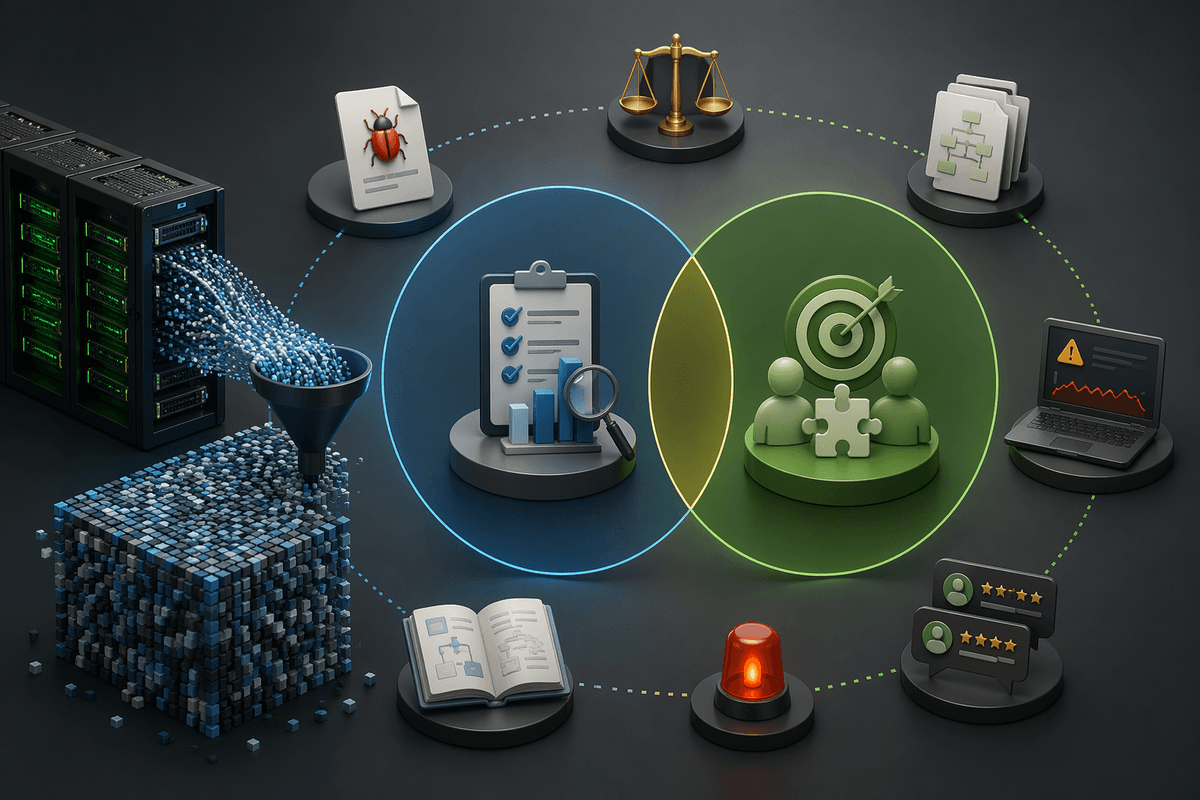
A common way self-learning loses its advantage is when the model starts “teaching to the judge.” If your filters rely on a style-biased grader or a narrow rubric, the loop selects for outputs that look correct rather than outputs that are correct. You see higher pass rates, cleaner reasoning traces, and better benchmark scores—until the model hits real inputs where correctness depends on messy constraints, tool outputs, or missing context.
Another quiet failure is feedback collapse: the synthetic data becomes too similar to the model’s existing habits. That can happen through prompt templates that never change, over-aggressive deduping that removes useful variation, or conservative thresholds that keep only the safest, most generic answers. The result is polish without new capability, and sometimes worse calibration because the model rarely practices being uncertain.
If you can’t cheaply test what users care about (production bugs, policy edge cases, domain facts), you either pay for heavy human review or you scale unverifiable data. At that point, you’ve rebuilt the labeling bottleneck—just with more GPU spend and more ways to hide errors.
When self-learning wins—and when it’s not worth it
You see self-learning pay off when you can define “correct” cheaply and at scale. Coding is the clearest case: unit tests, linters, and sandboxes can validate behavior without arguing about style. The same is true for structured tasks like SQL, math with verifiers, tool-use routines, and narrow enterprise workflows where you can compare against trusted logs or deterministic checkers. In those settings, synthetic data can target the long tail and keep iteration loops tight.
It’s usually not worth it when correctness is fuzzy, contested, or expensive to verify—open-ended writing quality, nuanced advice, or domain facts that require licensed sources and careful citation. If your validators can’t see the real failure (subtle policy issues, hidden safety risks, misleading but plausible claims), the loop mostly optimizes for looking right. You also need budget for generation and evaluation infrastructure; without it, “self-learning” becomes an expensive way to amplify noise.
A realistic takeaway: scaling efficiently means engineering the signal
In day-to-day terms, “self-learning” is just a trade: you spend compute and engineering effort up front to manufacture cleaner practice, then you hope to save more compute later by training on fewer, higher-signal tokens. The teams that benefit treat data quality as a system they can tune—generation prompts, diversity controls, validators, and hard held-out evals—not as a one-time dataset choice.
The practical takeaway is to ask one question before buying the narrative: what is your cheapest reliable notion of “correct”? If you can’t validate outcomes with tests, deterministic checks, or strong reference signals, self-learning tends to produce impressive-looking text with fragile truth. If you can, the bottleneck shifts to throughput, infra, and careful monitoring for judge-gaming and drift.