Why road behavior prediction suddenly matters to everyone
You’ve probably noticed how quickly driving has become a negotiation with signals you can’t always read: a pedestrian stepping off the curb while looking at a phone, a cyclist drifting around a parked car, a driver inching into your lane without a blinker. Road-behavior prediction is the AI attempt to turn those “what are they about to do?” moments into a forecast that driver-assistance systems, self-driving cars, and even smart traffic lights can act on.
It matters now because more vehicles are making automated decisions in real time, and those decisions increasingly affect people who didn’t opt in—everyone sharing the street. The promise is fewer crashes and smoother traffic; the constraint is that prediction isn’t certainty. Getting it wrong can mean hard braking, missed warnings, or risky moves, and making it work often requires collecting detailed data about where road users are and how they move.
What exactly is AI predicting on real streets
Picture a car approaching a crosswalk while a pedestrian slows near the curb. The prediction problem isn’t “will there be a pedestrian,” but “what will this person do in the next one to five seconds, and where might they be?” On real streets, AI typically forecasts short-horizon trajectories: likely paths, speeds, and timing for nearby cars, cyclists, and pedestrians. It also predicts events that matter for safety, like whether a vehicle will cut in, whether a cyclist will swerve around a door zone, or whether a pedestrian will commit to crossing.
Good systems don’t just output a single line on the road. They estimate how much space a road user might occupy, how quickly they could change course, and what rules or cues seem to apply (signals, lane markings, right-of-way patterns). The “intent” is inferred from motion and context, not read from minds, so the same behavior—like slowing—can mean yielding, hesitation, distraction, or a hidden obstacle.
The messy inputs: sensors, maps, and human context
In practice, prediction is only as good as the inputs feeding it, and real streets make those inputs messy. Cameras can miss a cyclist in glare or rain, lidar can struggle with some surfaces and heavy spray, and radar is great at speed but vague on shape. Even when each sensor “works,” their views don’t always line up: a pedestrian can be briefly hidden behind an SUV, or a turning truck can block the camera just long enough for the system to lose track and re-identify the wrong object.
Maps and road geometry help, but they’re not a cure-all. High-definition maps can be out of date after construction, temporary cones, or new paint, and GPS can drift in cities or under trees. The hardest input is human context: eye contact, hesitation, group behavior, and local norms like rolling merges. Systems try to approximate this with cues (head pose, turn signals, crosswalk location, typical traffic flow), but those cues are noisy, and collecting them at scale can raise privacy and oversight questions.
Models that forecast motion: from patterns to intent
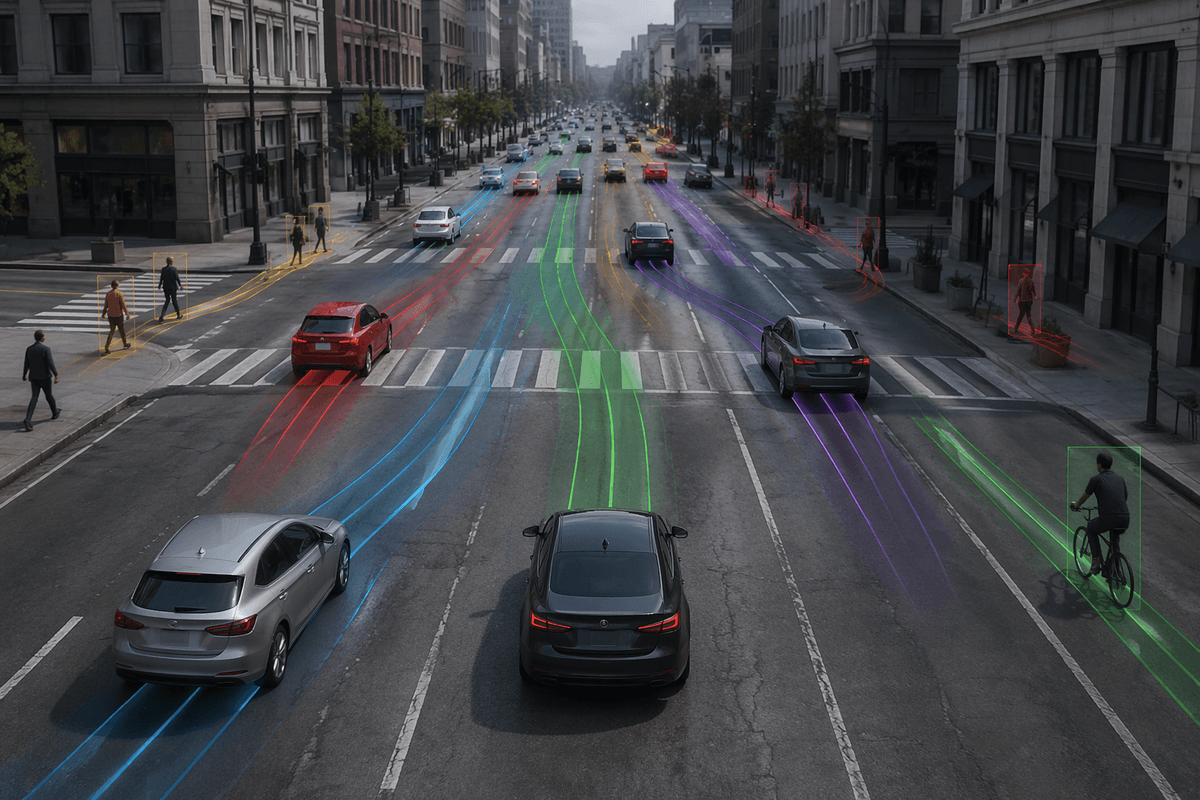
On a normal commute, the easiest things to predict are the repetitive ones: cars generally follow lanes, pedestrians usually stay on sidewalks, cyclists prefer straight lines until something forces a merge. Many prediction models start there, learning patterns from large amounts of driving data and then projecting what each road user will likely do over the next few seconds. That works well in steady traffic, where yesterday’s “typical” behavior looks a lot like today’s.
The harder step is moving from patterns to inferred intent. Some models treat the world as a set of possible “modes”: keep lane, change lanes, turn right, yield, cross, stop. They score each option using context like turn signals, gap size, crosswalk position, and traffic-light state, then generate several candidate trajectories rather than one. This approach can still misread situations that look similar from the outside—like a driver slowing to let someone in versus slowing for a pothole—so systems often trade comfort and confidence against safety margins, which can mean more cautious braking and occasional false alarms.
Uncertainty is the product: multiple futures, not one
If you’ve ever waited at an intersection thinking “they might go… or they might not,” you already understand what these systems are really selling: uncertainty estimates. Instead of committing to one predicted path, stronger systems output a handful of plausible futures for each nearby road user—continue straight, brake, turn, drift left, step into the crosswalk—each with a probability and a “spread” showing where that person or vehicle could reasonably end up.
That uncertainty feeds directly into driving decisions. If the model thinks a pedestrian has a 20% chance of crossing, the car may slow earlier to keep a safe buffer, even if the person ultimately stays put. If it sees two competing futures for the vehicle ahead—keep lane versus cut-in—it might avoid accelerating into a gap that could close fast.
The wider uncertainty usually means more cautious behavior, which can feel like unnecessary braking or hesitant merges. Narrow uncertainty can feel smoother, but it risks being confidently wrong when the scene is ambiguous.
When prediction fails: edge cases that break assumptions
You’ve likely seen the situations that don’t fit the “typical” patterns: an unprotected left turn where everyone creeps, a four-way stop with unclear right-of-way, or a cyclist weaving to avoid potholes and door zones. These edge cases break assumptions because the same motion can signal different intent, and the cues the model relies on (turn signals, lane lines, crosswalks, light state) may be missing, wrong, or ignored. Add occlusions—someone stepping out from behind a van—or a hand wave that never makes it into the camera view, and the system can assign high confidence to the wrong story.
Rare events are also underrepresented in training data: emergency vehicles pushing through traffic, informal construction detours, pedestrians crossing mid-block at night, or a car reversing unexpectedly. The practical difficulty is that “solve it with more data” has costs: collecting long-tail scenarios is expensive, labeling is slow, and privacy limits can restrict what gets stored. When prediction fails, the safest fallback often looks like hesitation or hard braking, which can create new risks if following drivers don’t expect it.
Deployment decisions: safety, privacy, and accountability tradeoffs
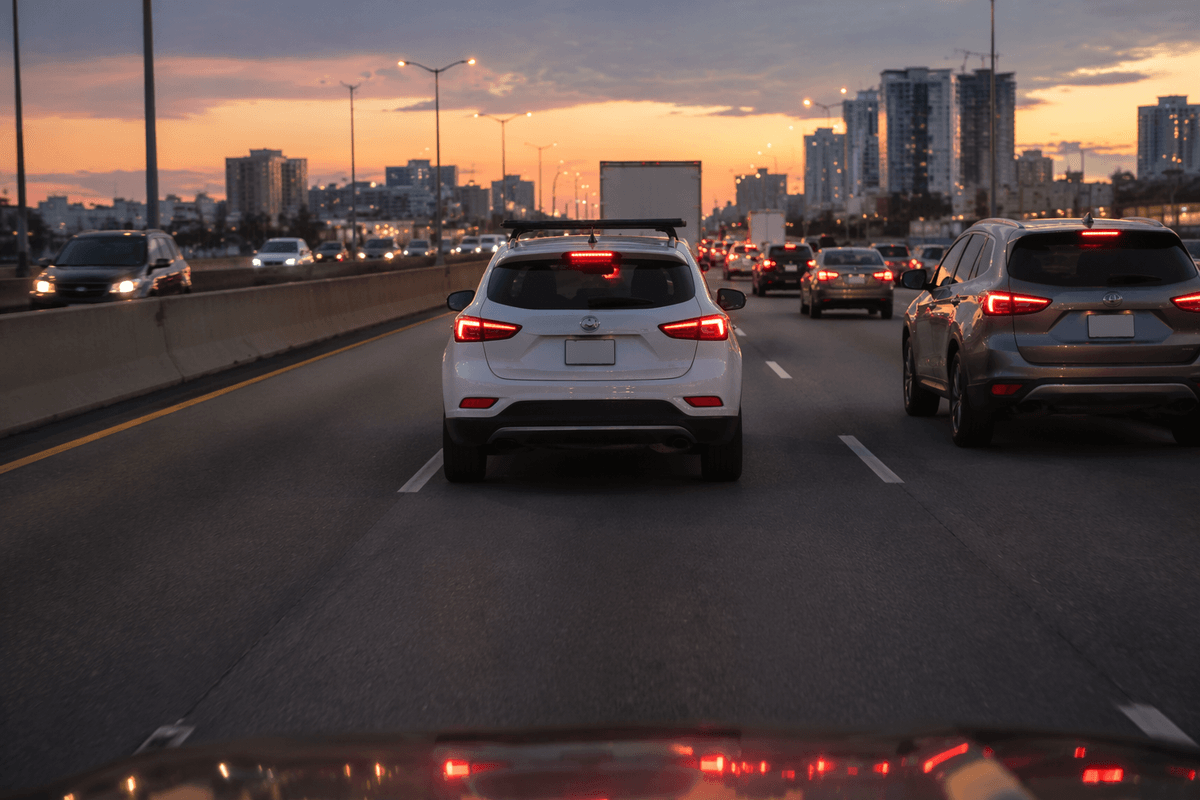
On the road, deployment choices show up as a personality: conservative or assertive. A system tuned for safety will treat uncertainty as a reason to slow, leave bigger gaps, and avoid tight merges. That can reduce crash risk, but it also brings costs—more false alarms, more abrupt braking, and “over-cautious” behavior that frustrates humans and can trigger rear-end conflicts. A system tuned for comfort and traffic flow may feel smoother, yet it risks acting on predictions that are too narrow when the scene is genuinely ambiguous.
Privacy tradeoffs follow from what gets recorded to make predictions better. Continuous video, precise location traces, and “near-miss” clips are valuable for debugging and retraining, but they can expose where people go, who they travel with, and bystanders who never consented. Minimizing data (processing on-device, short retention, aggressive blurring) helps, but it can slow improvement and make independent audits harder.
If the car braked because the model over-weighted a low-probability crossing, who answers: the automaker, the supplier, the fleet operator, or the driver who was told to supervise? Clear logs, incident reporting rules, and plain-language limits are not extras; they’re the only way to connect a prediction to a responsible decision.
How to judge road-behavior AI claims in the wild
When you hear “predicts what others will do,” ask what horizon and setting that means. Is it forecasting 1–5 seconds ahead on marked roads, or claiming “human-like” anticipation in construction, snow, and dense city scenes? Look for disclosures about where it was tested, how often it disengages, and how it handles occlusions and rare events. “Works in most cases” isn’t enough without numbers and clear boundaries.
Then ask what the system does when it’s unsure. Does it produce multiple plausible futures and choose safer gaps, or does it act like it has one answer? Pay attention to costs: false-brake rates, driver workload, and whether video/location data is stored, for how long, and who can audit incidents.