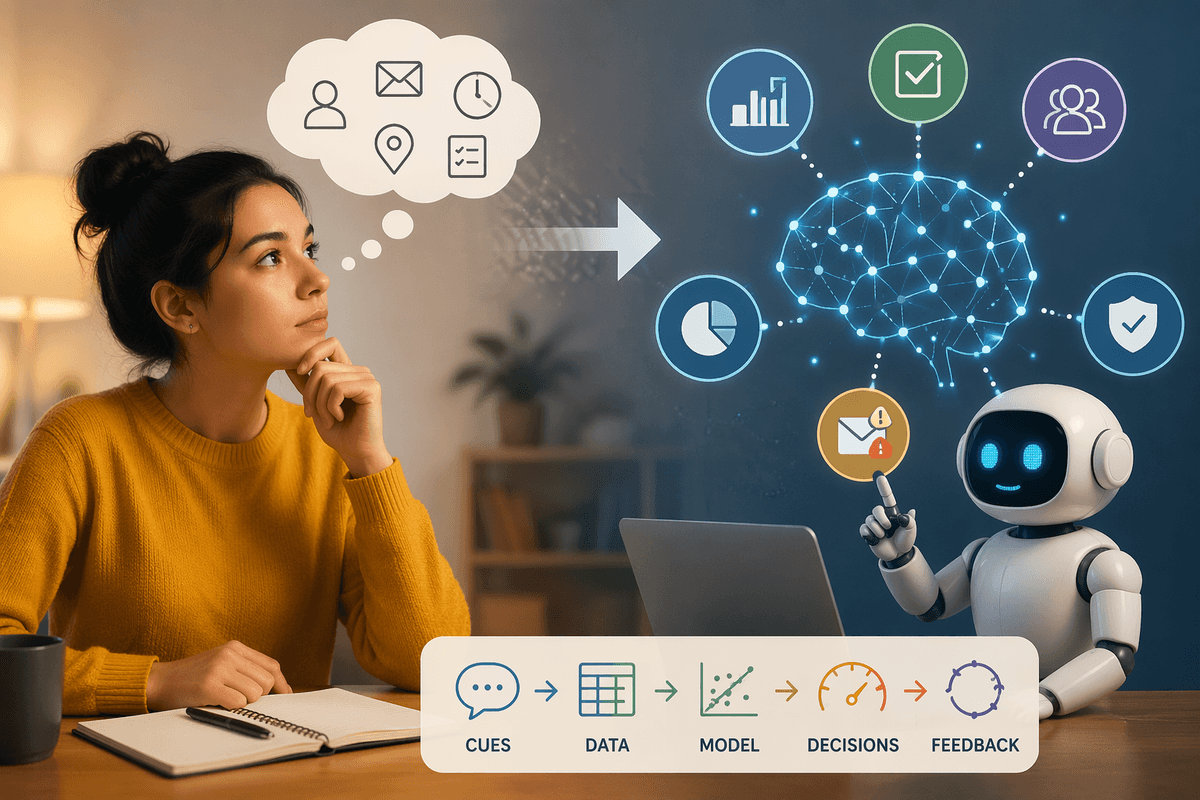
Why language feels easy for humans, hard for machines
You can skim a text message full of typos and still know what it means. You use shared background, tone, and the situation—who’s texting, what just happened, what “fine” probably implies right now. You also ignore most of what doesn’t matter, without noticing you’re doing it.
Machines don’t get that for free. To a model, language starts as symbols that need to be converted into numbers, then processed with rules learned from examples. Meaning isn’t stored as a tidy definition; it’s inferred from patterns across huge amounts of text.
That gap shows up in edge cases: sarcasm, local slang, missing context, and tricky references like “it” or “they.” Closing it usually means more data and compute, which raises cost, latency, and energy use.
From characters to tokens: how text becomes model input
When you type “I’ll be there in 10,” a model can’t work directly with the characters. It first breaks your text into tokens—small chunks that might be a whole word, part of a word, punctuation, or even a common ending like “-ing.” Different tokenizers slice the same sentence differently, which is why one “word” doesn’t always equal one token.
Each token is mapped to an integer ID from a fixed vocabulary, like looking up a code in a dictionary. That sounds simple, but it creates real constraints: rare names, new slang, or mixed-language text may get chopped into many pieces, using up the model’s context window faster and sometimes hurting accuracy. It also means the model can only “see” what fits inside that window at once.
Embeddings: turning words into numbers with meaning-ish
Those integer token IDs are just labels. The model still needs a way to represent that “dog” is closer to “puppy” than to “tax form.” It does this with embeddings: each token ID is turned into a long list of numbers (a vector) that the model can do math with. Tokens used in similar contexts during training end up with vectors that sit closer together, which gives the model a rough, usable sense of relatedness without any explicit definitions.
It’s “meaning-ish” because the vector depends on patterns in data, not grounded experience. “Apple” can lean toward fruit or a company depending on surrounding tokens, and unusual uses can confuse it. Embeddings also add cost: larger vectors and vocabularies mean more memory and compute, which affects speed and price.
Predicting the next token: the engine behind fluent output

Picture autocomplete on your phone: after “See you at,” it offers “7” or “home” because those continuations are common. A language model works the same way, just at a much larger scale. Given the tokens so far, it produces a ranked list of possible next tokens with probabilities. It doesn’t “retrieve” a finished sentence from memory; it builds one token at a time by repeatedly making that next guess.
During training, the model sees huge amounts of text and learns to reduce its mistakes at this guessing game. During use (often called inference), it applies what it learned to your prompt. Small choices matter: if you always pick the single most likely next token, the writing can sound stiff and repetitive; if you allow less-likely picks, it becomes more creative but also more error-prone. Each extra token also costs time and money because the model recomputes probabilities over and over.
Attention and transformers: how models use long context
You’ve seen the “it” problem: “Put the glass on the table. Then move it.” Humans resolve “it” by tracking what’s most relevant. Transformers approximate that with attention: for each new token, the model scores which earlier tokens matter most, and mixes their information to decide what comes next. It’s less like reading left-to-right and more like repeatedly asking, “Which parts of this text should I focus on right now?”
Attention is powerful because it can link far-apart details—names, dates, caveats, earlier definitions—without hand-written rules. It also has a real constraint: the more context you include, the more computation and memory it can take, which affects latency and cost. And “long context” isn’t the same as “reliable memory”: a model can still miss a crucial line, or over-weight a vivid but irrelevant detail.
Training data and objectives: what the model learns

People notice the output sounds “well read,” then assume the model must have learned facts. What it actually learns is a set of statistical habits from its training data: which kinds of words follow others, which styles match which situations, and which claims tend to appear together. The standard objective is simple: predict the next token as accurately as possible across a massive mix of text.
If training data contains lots of customer-support chats, the model gets better at polite troubleshooting; if it contains more code, it gets better at code-like patterns. It also inherits what’s overrepresented, outdated, or wrong. Cleaning and filtering help, but they cost time and money, and some errors only show up later when the model is used in unfamiliar contexts.
Where language processing breaks: ambiguity, bias, hallucinations
You see the cracks when language stops being “one obvious meaning.” Ask, “Can you book me a table by the bank?” and a human checks: riverbank or financial branch, and which city. A model may guess based on common phrasing, then continue confidently without pausing to clarify. The same happens with pronouns, sarcasm, and requests that rely on unstated shared context.
Bias shows up because training text reflects people and institutions, not an ideal sample of the world. If certain groups are talked about in narrower roles, or certain dialects are treated as “incorrect,” the model can mirror those patterns in subtle word choices, rankings, or assumptions.
Hallucinations are the most jarring failure: the model produces plausible-sounding details that weren’t in your prompt and may not be true. It’s still optimizing for “a likely next token,” not for verified accuracy, and checking facts usually requires extra tools, extra latency, and extra cost.
Using NLP well: prompt habits and reality checks
You’ve probably seen two very different results from the same tool: a crisp, helpful answer, and a confident mess. The difference is often the prompt. Give the model a concrete role and output format, include the key facts it must use, and ask it to state assumptions or ask clarifying questions when details are missing. If accuracy matters, request citations or “only use the provided text,” then paste the source.
Build quick reality checks into your workflow. Treat names, numbers, dates, quotes, and “too-perfect” explanations as items to verify elsewhere, because fluent wording is not evidence. For high-stakes tasks, use the model to draft, compare options, or generate checklists, then validate with reliable sources—accepting the extra time and tool cost that verification requires.