Why assistants plateau when humans step out of the loop
You’ve seen the pattern: the assistant looks great in a demo, then starts missing edge cases once it’s used for real tickets, real research, or real stakeholder writing. When humans step out, the system loses the “last-mile” checks that catch subtle policy exceptions, outdated facts, and context that isn’t written down anywhere.
It also stops getting clean feedback. If no one labels what was wrong and why, the assistant can’t separate a bad answer from a merely unusual one, so quality levels off. Even worse, teams quietly work around errors, which hides the true failure rate. Adding humans costs time and money, but removing them often just shifts the cost into rework and trust loss.
Define the job: what the assistant should handle alone
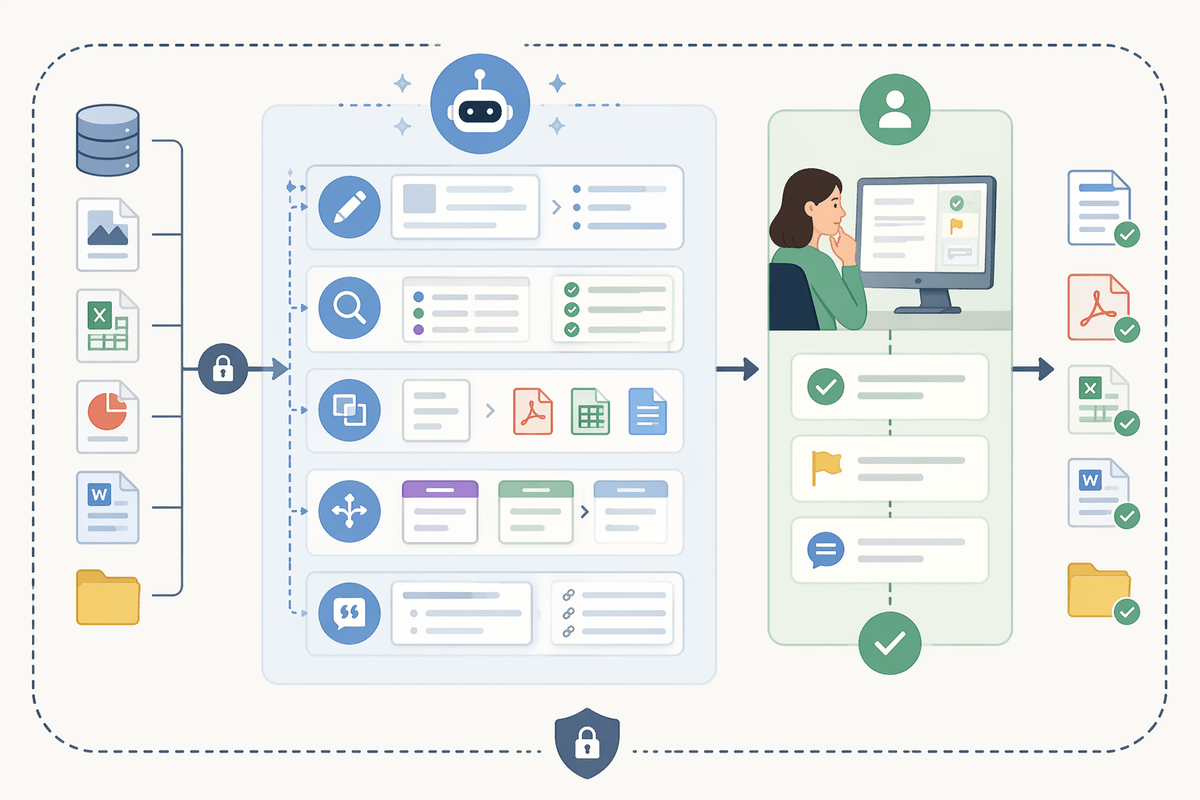
A practical way to start is to list the decisions your team makes every day and sort them by “safe to automate” versus “needs judgment.” Assistants do best when the job is bounded: drafting first passes, extracting facts from known sources, transforming formats, and proposing options with citations to internal docs. They struggle when the task depends on tacit context (what Legal will object to, which customer is high-risk, what “good enough” means for a VP) or when the input data is incomplete.
Define success as an output you can check quickly: a support reply that follows policy, a research brief with sources attached, a weekly ops update in your template. Then define what it must not do alone: policy exceptions, approvals, commitments, or anything that creates external risk. This constraint feels limiting, but it’s what keeps review lightweight instead of turning every use into a full redo.
Pick a collaboration style: review, co-draft, or delegate
A common starting point is “review”: the assistant drafts, a human checks for policy fit, factual correctness, and tone, then ships. This works when errors are easy to spot and the reviewer has a clear checklist (must cite the right source, must use the approved template, must not promise timelines). The cost shows up when reviewers keep rewriting from scratch; that usually means the task definition is still too fuzzy or the reviewer standards aren’t written down.
“Co-draft” is paired work: the human steers in smaller steps, asks for alternatives, and locks decisions as they go. It’s slower per document, but it prevents late-stage reversals in stakeholder writing, customer escalations, and anything where one wrong sentence creates risk. The signal is whether the assistant reduces thinking time, not just typing time.
“Delegate” is limited autonomy: the assistant completes the work inside guardrails and only escalates specific triggers (missing data, policy exception, high-value customer, external send). It pays off in ops and support queues, but only if you invest upfront in routing rules, logging, and a sampling plan to catch silent failures.
Turn human feedback into signals the model can learn from

A familiar failure mode is reviewers “fixing” the output but not leaving a trace the system can learn from. Treat feedback as structured data, not a vibe: was the issue factual accuracy, policy compliance, missing context, tone, or format? Capture the smallest useful label plus evidence (the correct source link, the policy clause, the missing field), so the same mistake is recognizable later.
Make the feedback cheap to give. Use a short rubric in the review UI (pass/fail by dimension, one-line reason, and whether the draft was salvageable). When edits happen, log diffs and require a quick “why I changed this” note on high-impact changes. Too much labeling turns into busywork, so reserve deep annotation for recurring error types and high-risk categories.
Turn the signals into action: update prompt templates, add retrieval targets, tighten escalation rules, and build a weekly error report that ties fixes to measurable outcomes (fewer rewrites, fewer escalations, faster time-to-ship).
Design the handoff: when to ask humans, and how
The handoff breaks down when the assistant either asks too often (“please clarify” loops) or not enough (confident guesses that force cleanup later). The practical goal is predictable interruption: humans get pulled in at the same points every time, for the same reasons, with the right context attached. Think of it like a triage lane in support: most items flow through, but certain conditions always trigger a stop.
Start with explicit escalation triggers tied to risk and uncertainty: missing required fields, no supporting source found, conflicting sources, policy exceptions, external-facing sends, or high-value accounts. The “how” matters as much as the “when.” Escalations should arrive as a compact packet: the draft, the sources used, what was assumed, what’s missing, and 2–3 concrete options for the human to choose or edit.
Routing rules, review queues, and audit logs take real setup time, and reviewers need a short checklist or they’ll revert to rewrites. A simple sampling plan (for example, review 10% of low-risk outputs) catches drift without turning every task into a meeting.
Measure improvement without gaming: accuracy, time, and trust
A familiar disappointment is watching “quality metrics” improve while the work still feels messy. If you only measure acceptance rate, reviewers learn to rubber-stamp. If you only measure time saved, people stop checking details. Use three linked measures: accuracy (was it correct), time (what did it cost), and trust (will people rely on it without hedging).
Accuracy needs a grounded target. Pick a small set of failure modes that matter—wrong policy, wrong fact, wrong audience, missing source—and score them on a sampled set each week. Track “severity-weighted” errors, not just counts, because one risky promise can outweigh ten minor formatting mistakes. The constraint is that auditing takes time, so use stratified samples: heavier review for new workflows, new templates, and external-facing outputs.
Measure draft-to-ship time, reviewer minutes, and downstream cleanups (reopened tickets, follow-up emails, stakeholder churn). Trust is observable in behavior: how often humans rewrite from scratch, how often they bypass the assistant, and whether escalations arrive with enough context to make decisions quickly.
Make it sustainable: roles, incentives, and continuous tuning
In a working system, “human in the loop” is a role with capacity, not a favor someone does between meetings. Assign an owner for prompts, retrieval sources, and routing rules, and a separate owner for quality auditing, so the same person isn’t both shipping and grading. Give reviewers a clear stop authority and a time budget; otherwise they will either rubber-stamp or rewrite.
Incentives matter more than tooling. If teams are rewarded for throughput alone, errors get hidden and learning stalls. Treat recurring failures like product bugs: log them, prioritize them, and ship small fixes weekly (template updates, better required fields, tighter escalation triggers). Budget for drift: policies change, sources move, and without routine tuning the assistant quietly gets worse.