Why “more data” stops working with real-world datasets
You can usually feel the “more data” ceiling when the next batch you collect looks a lot like the last one. The overall accuracy barely moves, but edge-case failures keep showing up in support tickets: unusual phrasing, rare product states, odd lighting, uncommon user workflows. Real-world datasets often follow a long tail, so new rows mostly add repetition instead of new coverage, while the hard cases remain underrepresented.
Past that point, the constraint is less “volume” and more “variety you can safely capture.” The rare examples you need are expensive to find, sometimes impossible to label reliably, and often tied to sensitive attributes you can’t store freely. Even when you can collect them, production data can contain hidden shortcuts—timestamps, UI versions, internal IDs—that a model learns as spurious signals. Adding more of that data can reinforce the wrong correlations instead of improving robustness.
That’s the practical opening synthetic data targets: getting controllable coverage where real data is sparse, risky, or slow to acquire. It won’t replace careful evaluation, but it can create the missing slices—rare intents, rare defects, tricky boundary conditions—without waiting months for them to appear naturally.
What counts as synthetic data (and what doesn’t)
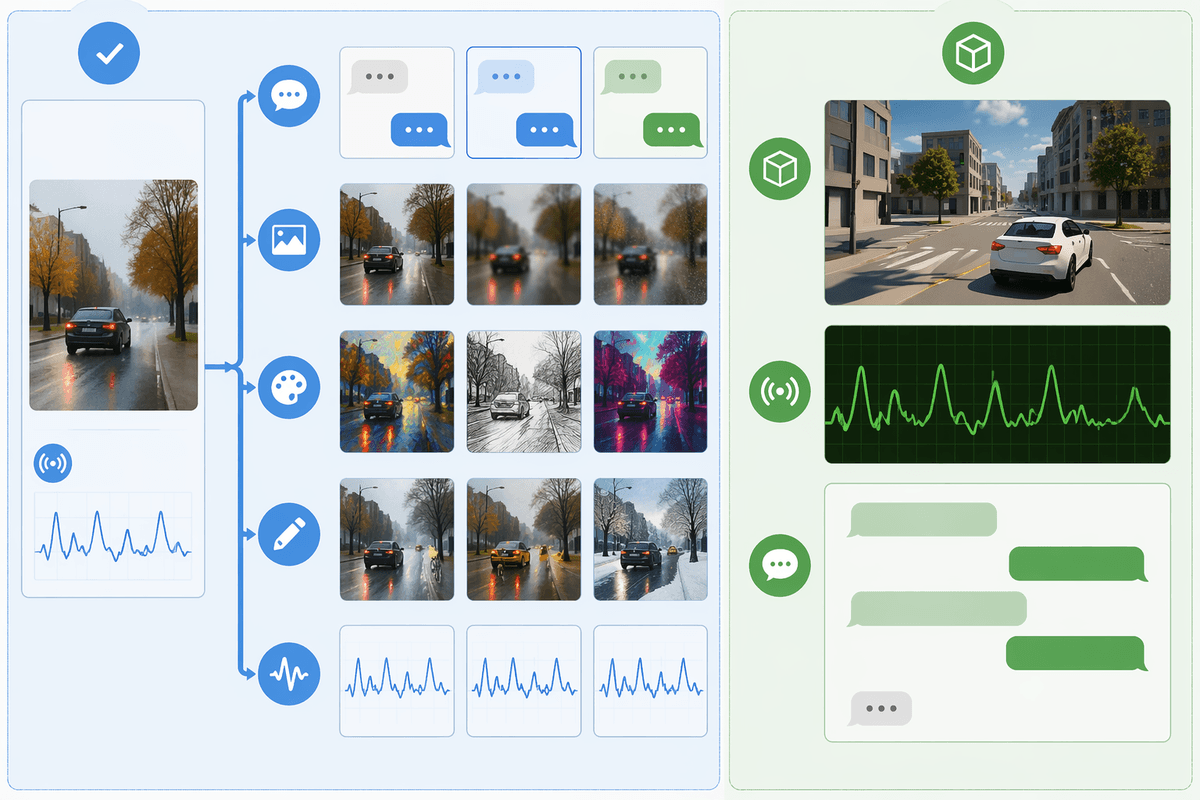
In practice, “synthetic data” means examples that didn’t come from direct observation of your users or environment, but are intentionally generated to match a target task. That can be fully artificial (rendered images, simulated sensor traces, generated text conversations) or “real-anchored” (starting from a real record and producing controlled variants: paraphrases, perturbations, style transfers, targeted edits). You can dial up rare conditions and label them consistently, instead of hoping they show up in the next data pull.
What doesn’t count, at least not in the way teams usually mean it, is just copying, reweighting, or lightly augmenting the same examples until the dataset is bigger. A train-test split leak disguised as “generated” data is also not synthetic—it’s contamination. Another common confusion is treating model outputs as ground truth. If you generate labels or whole examples from an existing model, you’ve created synthetic data, but you’ve also imported that model’s blind spots and biases as a cost of speed.
The three model problems synthetic data can actually fix
You’ll get the most value from synthetic data when you can name the specific model failure you’re trying to remove. The first fix is long-tail coverage: rare intents, rare defect types, uncommon UI states, or corner lighting conditions that barely exist in logs. If those cases are stable and well-defined, you can generate targeted slices and stop “waiting for reality” to deliver enough examples to learn the pattern.
The second fix is labelability. Some tasks fail because the real data is there, but labels are inconsistent, expensive, or slow (policy violations, complex taxonomies, fine-grained attributes). Synthetic examples can be created with crisp, auditable labels that teach the decision boundary more clearly. The trade-off is that overly clean synthetic labels can make the model brittle if you don’t also include messy real examples.
The third fix is safe iteration under constraints: privacy, compliance, or internal sensitivity. When you can’t store or share raw user data, synthetic sets can unblock debugging, vendor evaluation, and rapid experiments. The “privacy-safe” doesn’t guarantee “distribution-correct,” so you still need a real-data evaluation loop to avoid optimizing for a synthetic world.
Choosing the right generation approach for your task
A common choice shows up quickly: do you need “more of the same,” or do you need examples that behave differently? If you mainly lack coverage in a known format—rare intents in customer support, uncommon error states in logs—prompted LLM generation or programmatic templates can create labeled slices fast. If you need tight control over causality—lighting, camera angle, sensor noise, physics—simulation or rendering is usually the only way to vary factors independently without smuggling in hidden cues.
Real-anchored generation fits when you trust the core record but need breadth: paraphrases for intent classification, edited receipts for OCR, or perturbations that mimic production drift. The constraint is cost and fragility: building good generators takes time, and “easy” prompts often collapse into repetitive patterns that look diverse to humans but not to a model. When stakes are high, prefer approaches where you can trace each synthetic example back to explicit rules, parameters, or source records—and where you can regenerate the dataset deterministically when requirements change.
How to mix synthetic and real data without degrading accuracy
A familiar failure mode is a model that looks better in offline tests but gets worse on real traffic because training quietly shifted toward a synthetic “world.” Mixing works best when real data stays the anchor. Keep validation and test sets strictly real, and treat synthetic data as a targeted supplement tied to specific slices: the rare intents, boundary conditions, or confusing negatives you can name and measure. If you can’t describe the slice, you’ll usually over-generate the wrong thing.
Start with a conservative ratio (often 5–20% synthetic by count) and increase only when real-only baselines stop improving on the exact failure slice. Oversampling synthetic data can make the model overconfident, especially when synthetic labels are unnaturally clean or language is too consistent. A practical pattern is “real-heavy pretrain, synthetic-heavy targeted fine-tune, then a short real-only refresh” to pull the decision boundary back toward production. Expect real costs: extra training runs, slice-level evaluation, and periodic regeneration when product behavior or policies change.
Quality checks: proving synthetic data helps in production

The easiest way to fool yourself with synthetic data is to measure it on problems it was designed to solve. Keep your success criteria tied to real traffic: a frozen, strictly real validation set plus a “canary” slice that mirrors the failure you’re targeting (rare intent, specific defect type, hard lighting, confusing negatives). Track metrics that reveal shifts, not just overall accuracy—calibration, false-positive rate on high-cost classes, and per-slice confusion changes. If synthetic data helps, you should see improvement concentrated in the targeted slice without a broad regression elsewhere.
Run an ablation that forces accountability: real-only baseline, real+synthetic, and (when possible) “more real data” of similar labeling cost as a competitor. Add two red-team checks: train a simple classifier to distinguish synthetic from real (if it’s easy, your generator is leaving artifacts), and search for near-duplicates between synthetic and evaluation sets to catch leakage. The practical cost is time: slice labeling, extra training runs, and monitoring drift after release, because generators go stale as the product changes.
Risks you can’t ignore: bias, leakage, and compliance
A common temptation is to use synthetic data to “balance” a dataset by generating more of the classes you under-sampled. If you’re not careful, that creates a different bias: you over-represent the easiest-to-generate version of a minority class, while the real-world variation stays missing. The model learns a clean stereotype and then fails on messy reality. Treat demographic or sensitive-attribute balancing as a measurement problem first (slice metrics on real evaluation), then generate only the specific missing conditions you can describe, and keep a paper trail of assumptions.
Leakage is the quietest failure mode. Real-anchored generation can copy unique strings, IDs, or phrasing into synthetic records, and then near-duplicates slip into validation sets through joins or caching. The result looks like “great generalization” until launch. Put hard controls in place: de-duplication against eval sets, canary strings to detect copying, and an explicit rule that synthetic data can’t be generated from any record that might appear in test or production holdouts.
Compliance is less about whether data is “synthetic” and more about whether it can be traced, explained, and audited. Teams still need to track provenance (what sources or prompts produced the example), retention policies, and whether any personal data could be reconstructed. That adds operational cost: secure pipelines, review workflows, and periodic regeneration when policies change, not just a one-time dataset build.
A practical starting playbook for your next dataset gap
You notice the gap when a single slice keeps failing: “refund after partial shipment,” “photo in low light,” “policy exception in region X.” Write that slice as a checklist of conditions, then build a small, real holdout set that contains only those cases (and stays frozen). Choose one generator you can control—templates, edit-based variants, or a simulator—and generate just enough examples to cover the checklist, not “a balanced dataset.”
Train three runs: real-only, real+small synthetic (start ~10%), and “more real” for the same labeling budget if you can. Reject the synthetic mix unless the targeted slice improves on the real holdout without raising high-cost false positives elsewhere. Expect friction: de-duplication, prompt/version tracking, and regeneration when product flows or policies change.