Why AI energy use became a real product constraint
A few years ago, “AI efficiency” mostly sounded like a research goal. Now it shows up in product reviews and quarterly bills. As teams moved from demos to always-on features—chat, search, recommendations, copilots—the cost shifted from a one-time training run to continuous inference that scales with usage. That turns compute into an operating expense with real sensitivity to latency targets, peak traffic, and reliability requirements.
Energy is the physical constraint underneath those costs. Higher power draw means bigger cloud spend, tougher capacity planning, and sometimes hard limits in data centers (power delivery, cooling, rack density). Sustainability commitments add another layer: the same model can have very different emissions depending on where and when it runs. The practical challenge is that “more efficient” can also mean slower responses, worse accuracy, or more engineering complexity—so efficiency has to be evaluated as a product trade, not a slogan.
Find your biggest energy drains before optimizing anything
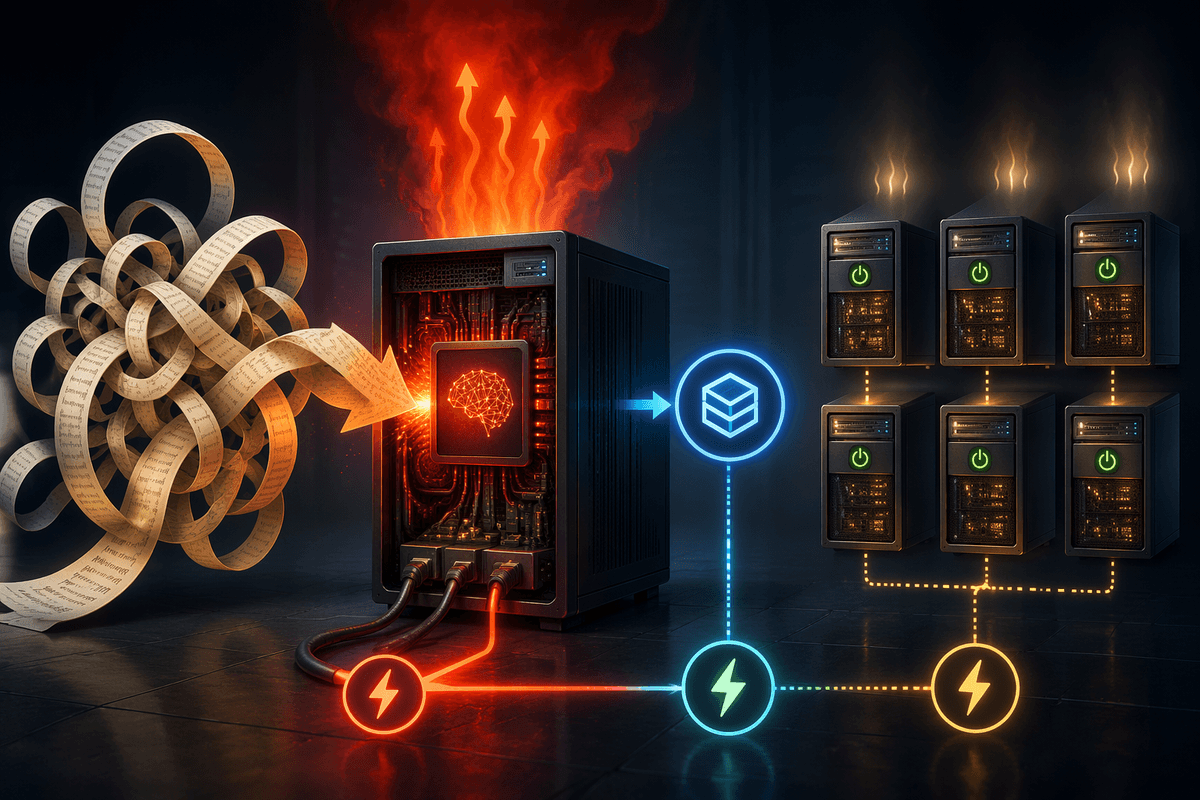
A common failure mode is optimizing the part you can see—shrinking a model or switching instance types—while the real energy burn hides in serving behavior. Start by measuring where joules go across a full request path: token generation, embedding/search calls, rerankers, safety filters, and the glue code that retries on timeouts. Add simple counters for tokens, batch sizes, cache hit rates, and p50/p95 latency by route, then tie them to hardware power or cloud cost per node-hour.
In many products, the biggest drains are self-inflicted: long prompts with repeated context, uncached “system” work done on every request, and over-provisioned replicas kept warm for rare peaks. The constraint is that good measurement takes time—instrumentation, sampling, and clean baselines—and you may discover the top offender is a cross-team dependency. You can usually get meaningful savings by fixing the top one or two hotspots before touching the model.
Model size isn’t everything: the accuracy-per-watt trade
Two models can deliver the same user-perceived quality while drawing very different power, and the larger one isn’t always the better deal. The practical question is accuracy-per-watt: how much task quality you get per unit of compute at your latency target. If your workload is mostly short classifications, retrieval, or structured extraction, a smaller model—or even a non-LLM model—can match outcomes with far less energy. For generative features, a medium model with better prompting, retrieval augmentation, or a domain-tuned variant often beats “just scale up” once you include the extra tokens a larger model tends to generate.
The trade shows up when you compress or distill: you usually save energy, but you may lose robustness on edge cases, safety behavior, or long-context reasoning. Quantize too aggressively and you can see subtle regressions that only appear under real traffic. Running an A/B on held-out benchmarks isn’t enough; you need a slice of production prompts, plus a cost model that includes prompt length, output length, and retries, because those can erase the theoretical savings.
Inference is the long tail: serving patterns that save power
A familiar pattern is watching a “cheap” model become expensive because of how it’s served. Inference cost is mostly a function of how many times you call the model, how many tokens you process, and how efficiently you keep the accelerators busy. If requests arrive one by one, you pay in idle gaps, small batches, and extra overhead per call. If you stream long outputs by default, you pay in tokens that users often don’t read.
The highest-leverage fixes usually look like product and systems hygiene: cache stable work (system prompts, tool schemas, frequent answers), trim repeated context, and use retrieval so you don’t paste entire documents into every prompt. Dynamic batching and request coalescing can raise utilization without changing quality, but they add queueing delay—so you typically apply them more aggressively on background tasks than on interactive flows.
Route traffic based on need. Use smaller models for drafting, classification, and guardrails; escalate to larger models only when confidence is low. Add early-exit rules (stop generation when the answer is clearly complete) and enforce token budgets per route. The constraint is operational: more routing, caching, and batching introduces complexity, harder debugging, and failure modes that can quietly shift load back to the most expensive path.
Training efficiently: spend energy where it buys learning

Most teams treat training as a big, rare spike, then repeat it more often than they admit: new data drops, prompt changes that require retuning, and “just in case” reruns after a metric wobble. The waste usually isn’t the core compute, it’s everything around it—too many long ablation grids, under-informative hyperparameter sweeps, and jobs that run to completion even when they’re clearly not improving. A simple rule helps: stop paying for steps that aren’t buying learning. Track marginal gain per GPU-hour and kill runs that fall below a threshold.
Put your energy into the parts that move the needle. Clean and dedupe training data, cap sequence lengths to what the task actually needs, and sample or curriculum-train instead of always using the full corpus. Prefer parameter-efficient finetuning when it meets quality, and only escalate to full finetunes when you can show durable lift. The constraint is process: you need reliable evals, automated early stopping, and reproducible pipelines, or “efficient” training turns into slower iteration and hard-to-trace regressions.
Right-size infrastructure: hardware, location, and utilization
Most teams overpay because they buy “peak” infrastructure and run it at “average” utilization. Look at your real duty cycle: how much of the day is interactive, how much is batch, and how spiky traffic gets. If your accelerators sit half-idle, efficiency claims about a faster chip won’t matter as much as packing work better. Consolidate models onto fewer, fuller nodes where latency allows, and split interactive from background queues so batching doesn’t slow user-facing routes.
Hardware choice is workload-specific. Memory bandwidth, KV-cache size, and supported precisions can dominate energy-per-token more than raw FLOPS, especially for long-context generation. The constraint is switching cost: new kernels, new quantization paths, and revalidating accuracy and safety behavior. Location and timing matter too. If you can shift non-urgent jobs, schedule them in regions and hours with cleaner grids or cheaper power, but expect trade-offs in data residency, egress, and operational complexity.
Make efficiency stick with budgets, guardrails, and incentives
Efficiency usually fades when it lives in a slide deck instead of a budget. Treat tokens, GPU-seconds, and cache misses like any other scarce resource: set per-route budgets, make overruns visible in dashboards, and require an explicit exception when a team wants to raise a cap. Put guardrails in code—max context, max output tokens, and “no retry storm” limits—so costs can’t silently climb with traffic.
Incentives matter because the “best” model often looks great in offline quality reviews while blowing up serving spend. Tie model changes to a simple scorecard: user metric lift, p95 latency, and energy/cost per successful task. Reward teams for reducing cost at steady quality, and plan for the practical cost: more instrumentation, more ownership, and occasional pushback when guardrails block a favorite approach.